In short
- The couple's table is the most photographed spot at the reception: flowers should frame you, not hide you.
- There are three main formats: long head table, sweetheart table and the couple seated at a long banquet table with guests.
- Front-facing arrangements stay low in front of the couple and can rise at the sides or behind.
- Think about evening light: candles, spotlights and where the table stands change how the flowers look in photos.
Top table flowers sit where you will spend most of dinner, watched by your guests and by the photographer's lens. This guide helps you choose the format, the shape of the arrangements and the right sizes, and gives you the questions to ask your florist. If you are still looking for someone to do your wedding flowers, start with our list of wedding florists in Italy.
Why the top table matters more than the others
Guests look at the couple throughout dinner: toasts, speeches, cutting the cake. The photographer frames that table many times, often from the front and from a distance. So the flowers on the top table have to work from three points of view:
- seated, because they must not bother you;
- from the room, because they need to read well even from ten metres away;
- in photos, because they should frame faces, not cut across them.
That does not mean spending much more. It means concentrating some of the work there, perhaps with fewer pieces on the other tables.
The three formats
| Format | What it looks like | Typical flowers | Watch out for |
|---|---|---|---|
| Long head table | Couple in the middle, witnesses or family at the sides, all facing the room | Long front arrangement, garland or cascade from the edge | Length: it takes more flowers than you think |
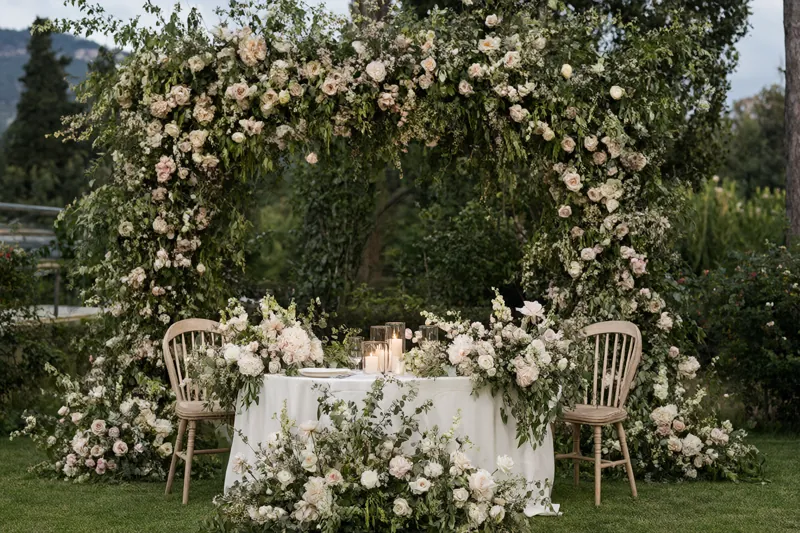
| Sweetheart table | Small table just for the two of you | Compact front arrangement, sometimes an arch or backdrop behind | It must not look isolated: link it to the rest of the room |
| Couple at a banquet table | Seated in the middle of a long table with guests | The centrepiece continues, with a fuller section in front of you | Keep height in check: guests opposite need to see you |
The sweetheart table is popular with couples from abroad marrying in Italy, and many Italian couples like it too. The long head table is still common at weddings where witnesses and family sit beside the couple. No format is right in absolute terms: it depends on the room, the number of guests and how you want to experience dinner.
The front arrangement: shapes and sizes
The most common solution is a front-facing arrangement: flowers set along the edge of the table facing the room. Some variations:
- a continuous garland of flowers and greenery, resting on the table or fixed to the edge;
- a cascade falling from the edge towards the floor, very photogenic but more expensive and delicate;
- grouped arrangements, low in the middle and taller at the ends;
- a backdrop behind you: a structure with flowers or greenery behind the chairs, useful in large rooms or outdoors with no natural background.
Exact sizes are decided by the florist on site. The practical rule is simple: in front of your faces the arrangement stays low, so you are fully visible when seated. Height and volume can build at the sides and behind. Always ask to test the seating during the site visit, with a real chair.
The table surface needs room for plates, glasses and perhaps the cake when you cut it. A garland that is too wide makes service awkward for the waiters.
Daylight and evening light
Many receptions start at sunset and finish in the dark. Flowers change a lot with the light:
- white and pale colours stay readable even in low light;
- dark colours (burgundy, deep purple) risk disappearing in the evening;
- candles add warmth but only light things close by;
- a dedicated spotlight on the top table helps the photographer a great deal.
Think about where the table stands too. With your backs to a window or to the sunset, the photographer works against the light. With your backs to a blank wall, a backdrop of greenery or flowers can make all the difference. Read our guide to lighting and flowers for more.
Candles and safety
Candles and flowers go well together, but every venue has its own rules. Many ask for:
- candles inside glass cylinders or closed holders;
- a minimum distance from fabrics, long tablecloths and dried flowers;
- in some cases LED candles only, especially in historic houses.
Ask the venue for its written rules before designing. The florist will adapt the set-up.
Reusing ceremony flowers
Moving arrangements from the church, the town hall or the outdoor ceremony to the top table is very common. It works well with:
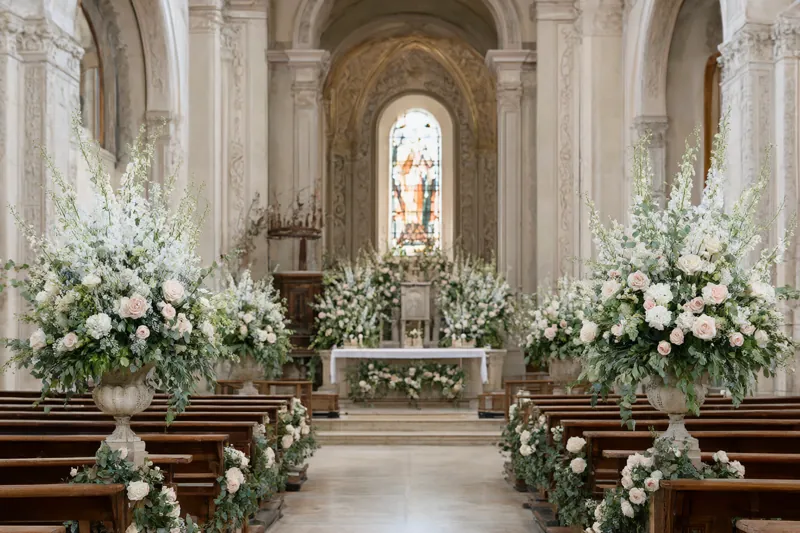
- arrangements beside the altar, which become the ends of the head table;
- aisle garlands, which become the table garland;
- the bridal bouquet, set in a vase in front of you during dinner.
It takes organisation, though: someone from the team has to move the flowers during the aperitivo, with a vehicle and enough time. If the church and the reception are far apart, reusing can cost more hours of work than it saves. Ask the florist to list it as a separate line in the quote.
Linking it to the rest of the room
The top table does not stand alone. It has to talk to the guest centrepieces, the seating plan and the laid tables. A few tips:
- the same colour palette, perhaps more intense on the top table;
- the same lead flowers, in different quantities;
- linens and chairs coordinated with the caterer or the hire company.
A sweetheart table with flowers very different from the rest can look disconnected. One identical to the other tables may not stand out.
Outdoor receptions and destination weddings
Outdoors, wind, sun and insects come into play. Light garlands shift and tall arrangements fall. You need heavy bases, containers with a water supply and flowers that cope with heat. If your wedding is in summer, read our guide to flowers that cope with the heat too.
For couples coming from abroad, a sweetheart table is often a starting request. Tell the florist and the venue straight away: some rooms are designed for a long head table and the layout will need rethinking.
Budget: where to invest on the top table
If your budget is limited, the top table is one of the places where flowers give the most, because it appears in so many photos. A few choices help keep costs down without it showing:
- reuse ceremony arrangements, as above;
- use plenty of greenery and a few lead flowers, concentrated in front of you;
- choose seasonal flowers, easier to find in quantity;
- slightly scale back the guest centrepieces to move resources to the top table.
Ask the florist to list the top table separately in the quote: it makes proposals easier to compare and decisions clearer.
Questions to ask your florist
- Which format do you suggest for this room and this number of guests?
- How tall will the arrangement in front of us be when we are seated?
- Will you reuse the ceremony flowers? Who moves them, and what does it cost?
- How will the flowers look in the evening light? Do we need a spotlight?
- Which candles does the venue allow, and how will you work them into the design?
- How will you fix the garland or cascade to the table?
- Can we see a trial photo or a mock-up before the day?
- What happens to the top table flowers at the end of the night?
Final thoughts
The top table is designed together with the room: sizes, light and your guests' sightlines matter as much as the choice of flowers. For the bigger picture, read our guides on how to choose a wedding florist and how much wedding flowers cost.
Once you have your date, venue and guest numbers, request a quote and say which top table format you prefer.