In short
- A seating plan is first of all for finding your table: legibility comes before flowers.
- The work is split between a designer or stationer (names and printing) and the florist (structure and flowers).
- In the heat, or when it is set up early, consider dried or preserved flowers, or hardy greenery.
- Floral place cards must last hours out of water and not stain the tablecloth.
The seating plan, often called a seating chart in the US and a tableau de mariage in Italy, is the board that tells guests where to sit. It is also one of the first things they see as they arrive at the reception, and one of the most photographed. This guide explains how to combine flowers and paper without losing the point of it, with ideas, materials and practical questions. To find someone to make one in your area, start with our list of wedding florists in Italy.
What a seating plan is really for
Before it is decoration, a seating plan is a sign. Dozens of people read it at the same time, often holding a glass and with the light fading. It works when:
- names can be read from a couple of metres away without squinting;
- several people can look at it at the same time without crowding;
- it is clear where the tables it refers to are;
- it stands where people pass but does not block the way into the dining room.
Flowers come second: they frame, add colour and tie the plan to the rest of the décor. If they cover names or make the board hard to read, scale them back.
Floral seating plan ideas
| Idea | How it is made | Suits | Watch out for |
|---|---|---|---|
| Board with a floral frame | Rigid board with printed names and flowers on one side or a corner | Almost any venue | Weight and stability of the easel |
| Written mirror or acrylic | Names written or printed on the surface, flowers at the base or top | Villas, elegant rooms | Reflections in photos, legibility at night |
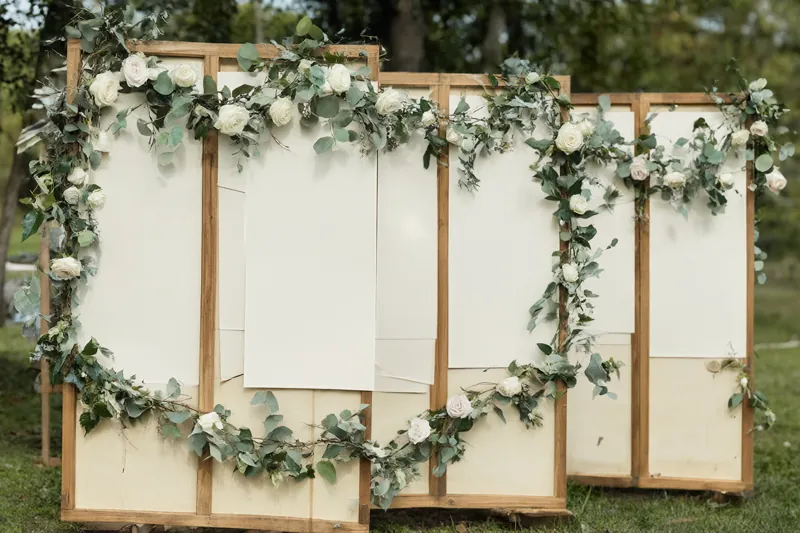
| Wood or iron frame with greenery | Frame with climbers or foliage and hanging cards | Gardens, countryside, masserie | Wind outdoors |
| Cards hanging from branches or wires | One card per table, hung with ribbons | Relaxed weddings | Cards that twist or blow away |
| Table with arrangements and cards | A table with vases and names grouped by table | Indoor rooms, little vertical space | Space taken up, guests touching things |
| Real plants or small trees | Pots with plants and cards, then reused or given away | Sustainable weddings | Weight, transport |
These are common options, not a closed catalogue. The plan can pick up the theme of your wedding: a place, a journey, a passion. At weddings in Sicily or on the Amalfi Coast, for example, you often see citrus branches and ceramics.
Flowers and paper: who does what
A seating plan brings two trades together. Clarify roles from the first meeting:
- Designer or stationer: guest list, layout, fonts, printing of the board or cards, plus any place cards and menus.
- Florist: the supporting structure if it is floral, flowers, greenery, setting up on site and taking down.
- Wedding planner, if you have one: coordinates timings, position and deliveries.
- Venue: says where it can go and whether anything can be fixed to walls or trees.
The critical point is the final table list. It often changes until the last week. Agree with the stationer how late you can change it and send it in a clear format.
Legibility: the practical rules
A few points make a seating plan genuinely useful:
- high contrast between text and background: black on white, white on dark, never pale gold on cream;
- readable fonts for names, even if the heading is in decorative script;
- names in alphabetical order within each table, or one overall alphabetical list with table numbers;
- with many guests, several panels or one long panel to avoid a queue;
- text at eye height, not only low down;
- lighting on it if the reception goes on after dark.
For international guests at a destination wedding, consider table names that are easy to pronounce, or a number next to each name. For other matching signs, read our guide to floral welcome signs.
Fresh, dried or preserved flowers
The seating plan is often set up hours before the reception and stays outdoors or in an entrance. Choose flowers accordingly:
- Fresh flowers: more alive and fragrant. They need water or water tubes, and suffer in direct sun.
- Greenery: eucalyptus, olive, ruscus and other foliage hold up well and cost less.
- Dried and preserved flowers: they do not wilt, can be prepared in advance and kept. They suit hot weather. Read our guide to dried and preserved flowers.
Many seating plans mix all three: a base of greenery, a few fresh lead flowers, dried details.
Floral place cards
Place cards carry each guest's name on the plate or glass. They can be finished with:
- a sprig of aromatic greenery (rosemary, olive, lavender) tied with ribbon;
- a small flower tucked into the napkin;
- a mini potted plant that doubles as a wedding favour;
- a dried flower glued to the card.
Points to watch: they must last without water all through dinner, must not stain pale tablecloths and must not drop pollen on plates. If they sit near food, choose plants with your florist that are suitable and not treated with products unfit to be near food. Our guide to flowers near food explains what to avoid.
Position, set-up and wind
The seating plan belongs where guests pass between the aperitivo and dinner, with room in front to stop. During the site visit, check:
- whether the ground is level (lawns and gravel make easels wobble);
- whether it is windy, especially by the sea or a lake;
- whether anything can be fixed to walls, trees or railings;
- who moves it if it rains and the reception goes indoors.
For tall structures outdoors, ask for weights or heavy bases. A seating plan that falls over mid-aperitivo is a safety problem as well as an eyesore.
After the party: what to do with the seating plan
Seating plans are often left behind at the end of the night. Decide beforehand what will happen to yours:
- fresh flowers can be given to guests or taken away by the florist for composting;
- dried and preserved flowers can be kept, perhaps split into small bunches;
- the printed board or written mirror can become a keepsake to hang at home;
- hired supports (easels, frames, mirrors) go back to the supplier and must be returned intact.
Say who will separate what is yours from what is hired. If take-down happens at night after the party, it is worth putting it in writing in the quote.
Seating plans for destination weddings and international guests
At weddings with guests from several countries, the seating plan has a few extra jobs. It can help to write the heading in two languages, use table names everyone can read and write guests' names as they appear on their documents, without nicknames. If the reception is at a villa with several spaces, a small map next to the plan helps people find the right room.
Questions to ask your florist
- Do you supply the seating plan structure, or is it hired separately?
- Do you usually work with a stationer? How do you coordinate?
- How many hours before do you set it up? Will the flowers last until evening?
- How do you keep it stable outdoors?
- Are floral place cards included? Who puts them on the tables?
- At the end of the night, do we keep the seating plan or does it go back as a hired item?
Final thoughts
A good seating plan can be read in seconds and looks good in photos. To design it together with the rest of the room, read our guides to wedding centrepieces and renting vases and structures.
Once you have a date and an idea of style, request a quote with your guest numbers and where you plan to put the seating plan.