In short
- The welcome sign is the first thing guests see: it must look good and be easy to read.
- Design and flowers often come from two different suppliers: get them talking.
- Outdoors you need stable stands, high-contrast lettering and flowers that cope with sun.
- Design reusable pieces: the same easel can serve both ceremony and reception.
The wedding welcome sign, the menu, arrows to the car park, the seating chart. This is your wedding signage, and its job is to guide guests. With flowers it also becomes part of the design. This guide is for anyone who wants to know what is really needed, which materials to use and who makes it. If you are looking for someone who handles flowers and full styling, start with the list of wedding florists and ask whether they also do signage.
What signage includes
| Item | Where it goes | Purpose |
|---|---|---|
| Welcome sign | Ceremony or venue entrance | Greets guests and confirms they are in the right place |
| Order of the day | Entrance or aperitivo | Shows timings for ceremony, dinner, cake cutting |
| Direction signs | Junctions, car parks, stairs, toilets | Guide guests around large venues |
| Seating chart (tableau de mariage) | Before the dining room | Tells each guest their table |
| Menu | On tables or a panel | Lists the courses and often the allergens |
| Bar or confettata signs | Next to each station | Explain what is there and how it works |
| "Unplugged" sign | Ceremony entrance | Asks guests not to use phones during the ceremony |
You do not need all of them. In a small villa, a welcome sign and the seating chart are enough. In a hilltop village (borgo) or a large estate, direction signs become essential. The confettata, by the way, is the Italian sugared-almond table: a sign explaining it helps guests from abroad.
The welcome sign
It is the first piece of styling guests come across, and often one of the most photographed. It usually carries the couple's names, the date and a welcome line.
Common formats
- On an easel, tall enough to read without bending down;
- On a mirror, with white or gold lettering;
- On acrylic, clear or coloured, very popular outdoors;
- On wood, suited to vineyards, masserie (Apulian farmhouses) and the countryside;
- On canvas or fabric, hung from a frame or an arch.
Where the flowers go
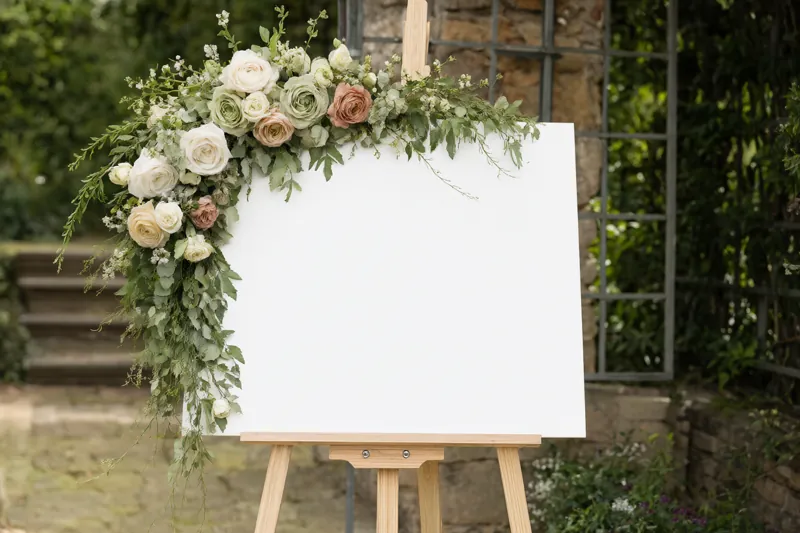
Flowers can sit in a corner of the sign, at the foot of the easel or all around it. An asymmetric arrangement at top left and bottom right is a common choice because it leaves the text clear. What matters is that the flowers do not cover the lettering.
The seating chart
It is the most consulted sign of the day: every guest has to find their name. With many guests a queue forms, so:
- list names in alphabetical order by surname, or by table if the group is small;
- use large, clear lettering;
- put the chart somewhere spacious, not in a narrow passage.
For flower ideas specific to this piece, read the guide to the floral seating chart and place cards.
Readability first
A beautiful sign nobody can read is a useless sign. The practical rules:
- strong contrast between lettering and background: white on mirror can vanish in full sun, black on dark wood is hard to read at night;
- fonts that are not too ornate for practical information: script is fine for names, less so for a list of tables;
- sizes that suit the reading distance;
- light: if the sign is still in use after sunset, it needs its own lighting.
For lighting, read the guide to lighting and flowers.
Languages: Italian weddings and destination weddings
If some guests come from other countries, think about the language of your signs. The most common solutions are:
- a bilingual sign, Italian and English;
- English as the shared language for an international wedding;
- Italian only for decorative pieces and bilingual for directions.
The menu needs care: allergens must be shown in a way everyone understands. The caterer decides on this and is responsible for it. If you are planning from abroad, the guide to a destination wedding in Italy explains other customs worth knowing.
Materials and climate
| Material | Pros | Watch out for |
|---|---|---|
| Acrylic | Modern, light, copes with humidity | Sun glare, scratches |
| Wood | Warm, rustic, stable | Weight, lettering hard to read in the dark |
| Mirror | Elegant, reflects light | Fragile, heavy, glare |
| Foam board or rigid card | Affordable, precise printing | Does not like rain or wind |
| Canvas | Soft, theatrical | Must be well secured, moves in the wind |
Outdoors, wind is the main enemy. A light easel with a heavy arrangement on top falls over easily. Ask for weighted bases or floor-standing supports. If there is a risk of rain, prepare a version for the covered space: the guide to a rain plan B helps you organise it.
Flowers suited to signage
Flowers on signs often sit out of water or with a small water source, and sometimes in the sun for hours. These work best:
- hardy greenery, such as eucalyptus, olive and ruscus;
- dried or preserved flowers, which do not wilt;
- sturdy fresh flowers, with hidden water tubes.
Avoid delicate flowers that droop within a few hours.
Who makes what
In practice there are three models:
- Full-service florist: handles the stand, design and flowers. Simpler, less coordination.
- Stationer plus florist: the stationer designs and prints, the florist decorates. Sizes and delivery need coordinating.
- DIY plus flowers: you make the sign, the florist adds the flowers. Fine if you are reliable with deadlines.
In every case, decide who brings the sign to the venue and at what time. Often the stationer delivers to the florist a few days before. If you are making signs at home abroad, consider how they will travel: large rigid pieces are awkward on a plane, so printing locally may be easier.
Reuse during the day
A good plan lets some pieces move:
- the welcome easel goes from the ceremony to the aperitivo;
- the flowers from the sign become an arrangement for the bar or dessert table;
- the order of the day becomes a sign for the after-party.
Make clear who moves things: the florist's team, the venue or the wedding planner.
What signage costs
There are no reference figures that apply to everyone. The price depends on a few items: material and size of the board, design or calligraphy work, quantity of flowers, hiring or buying the easel, transport and set-up. An engraved acrylic sign is priced differently from a printed card. Ask for a quote that separates board, design and flowers, so you can decide where to spend. It often makes sense to invest in the welcome sign and seating chart, the most seen, and keep direction signs simple.
Common mistakes to avoid
- Too many signs: every extra panel is another thing to transport, set up and light.
- Long texts: guests read standing up, often with a glass in hand.
- Wrong names on the seating chart: have two different people check the list before printing.
- Last-minute delivery: if the sign arrives the same morning, nobody has time to fix a mistake.
Questions to ask the florist
- Do you handle design and boards as well, or only the flowers?
- Which materials do you recommend for my space and season?
- Which flowers last out of water for the whole day?
- Are the easels stable outdoors? Do they have weights?
- Who moves the signs from one space to another?
- Are the stands hired or do I buy them?
To wrap up
Signage is small, but it walks your guests from arrival to the dance floor. Choose a few pieces that are readable and well made. To understand how hired stands and structures work, read the guide to hiring vases and structures.
When you have a date, a venue and a guest count, ask for a quote and ask whether signs and signage are included.