In short
- In Italy you can choose a civil ceremony, a religious ceremony with civil effect, or a symbolic one: only the first two are legally binding.
- The starting point for paperwork is the nulla osta, or an equivalent statement from your own country.
- Rules change by nationality: the consulate and the town hall's civil registry office have the final word.
- The symbolic ceremony is a popular choice because it leaves you free on place, time and language.
Getting married in Italy as a foreign couple is possible, but the steps depend on the ceremony and on your nationality. This guide is for couples living abroad who want to marry in Italy, and for anyone marrying an Italian or a foreign partner here. It explains, in plain terms, the differences between the ceremonies, the paperwork in general, timings and who to contact. It does not replace official information: rules depend on nationality and can change, so always check with the town hall (Comune) and with your consulate. If you are already looking for someone to do your flowers, see our list of florists for destination weddings in Italy.
The three ceremonies compared
| Civil | Religious with civil effect | Symbolic | |
|---|---|---|---|
| Legally binding | Yes | Yes, once registered | No |
| Who officiates | The mayor or a delegate | A minister of religion | Anyone you choose (celebrant, friend) |
| Where | Town hall room or a place authorised by the Comune | Church or place of worship | Anywhere, with the owner's permission |
| Paperwork | What the Comune requires | The Comune's and the church's | None for the state |
| Freedom over time and language | Limited | Limited | Wide |
The civil ceremony
A civil wedding is performed before the Comune's registrar. It can take place in the town hall or in a place the Comune has authorised as a venue: a villa, a castle, a historic house. Not every venue is authorised, so ask straight away.
You usually need two adult witnesses. If one of you does not understand Italian, the Comune will normally require an interpreter. Each Comune sets its own dates, times and room fees.
The religious ceremony
A Catholic wedding can also have civil effect: after the ceremony the marriage is entered in the civil registers and is valid in law. To get there you need two parallel tracks:
- the religious one, with documents from your home parish and from the Italian diocese;
- the civil one, with the documents the Comune asks for.
The religious paperwork can take a long time: start early and ask your home parish what is needed. For other faiths the rules differ: ask the religious community and the Comune.
The symbolic ceremony
A symbolic ceremony has no legal effect. Many international couples choose it, for several reasons:
- it can take place wherever you like: a private beach, a garden, a terrace, a vineyard;
- you choose time, language and celebrant freely;
- it does not depend on Italian bureaucracy: you marry legally in your own country, before or after;
- it suits couples who are already married and want to renew their vows.
The place still belongs to someone. You need the permission of the owner or venue and, for public spaces, of whoever manages them. Our guide on eloping and micro weddings in Italy covers this too.
Paperwork in general terms
The exact requirements depend on your nationality and on the Comune. In general, for a legally binding wedding you will be asked for:
- a valid ID, usually your passport;
- a birth certificate or equivalent document;
- the nulla osta (certificate of no impediment): a statement from your authorities that nothing prevents the marriage under your law. Article 116 of the Italian Civil Code requires it for foreigners marrying in Italy. Some countries issue it through their consulate in Italy, others use different declarations, sometimes sworn;
- if you have been married before, documents proving divorce or widowhood.
Documents issued abroad often need to be legalised or apostilled and translated into Italian. Between EU countries, some public documents move under simplified rules with multilingual forms. Other steps, such as the publication of banns, may or may not apply depending on where you live: ask the Comune.
Same-sex couples in Italy have access to a civil union (unione civile), governed by a specific law and different from marriage. If this applies to you, check with the Comune and your consulate how it works for your nationality.
Timings and the order of things
- Choose the ceremony. It decides which documents you need and where you can marry.
- Contact the Comune where you will marry, at the civil registry office (ufficio di stato civile): date availability, documents, fees.
- Contact your consulate in Italy or your home authorities about the nulla osta.
- Prepare the documents, with legalisation and translations. Some have limited validity: do not request them too early.
- After the wedding, ask the Comune for the marriage certificate and register it in your own country, as your consulate advises.
Destination weddings are often planned many months ahead. The overall timeline is in our guide to a destination wedding in Italy.
Common mistakes to avoid
Some problems come up again and again for couples marrying in Italy from abroad:
- booking the venue before checking it is authorised for civil weddings, and finding out too late;
- relying on second-hand information, found online or told by friends of a different nationality: rules vary from country to country;
- requesting documents too early, so they expire before the date;
- forgetting translations and legalisation, which take time;
- not arranging an interpreter when one of you does not speak Italian;
- assuming a symbolic ceremony is legally binding: for the state it does not exist, so you need a separate valid civil marriage.
A practical tip: write to the Comune and to your consulate with the date, both nationalities and your chosen ceremony. Ask for a written reply and keep it.
Who does what
| Who | What they tell you or give you |
|---|---|
| The Comune's civil registry office | Required documents, dates, authorised rooms and venues, interpreter |
| Your country's consulate or embassy | Nulla osta or equivalent statements, registration at home |
| Parish or religious community | Religious preparation and documents |
| Wedding planner | Practical help and coordination, but no substitute for the offices |
An experienced wedding planner knows the most common procedures and can guide you, but the final word always belongs to the Comune and the consulate.
And the flowers?
The ceremony you choose also changes your flowers a lot:
- at the town hall, timings are tight and the room is shared with other couples: a few arrangements, easy to set up and remove. See flowers for a civil ceremony;
- in church, the parish rules on altar, pews and timings apply. See church wedding flowers;
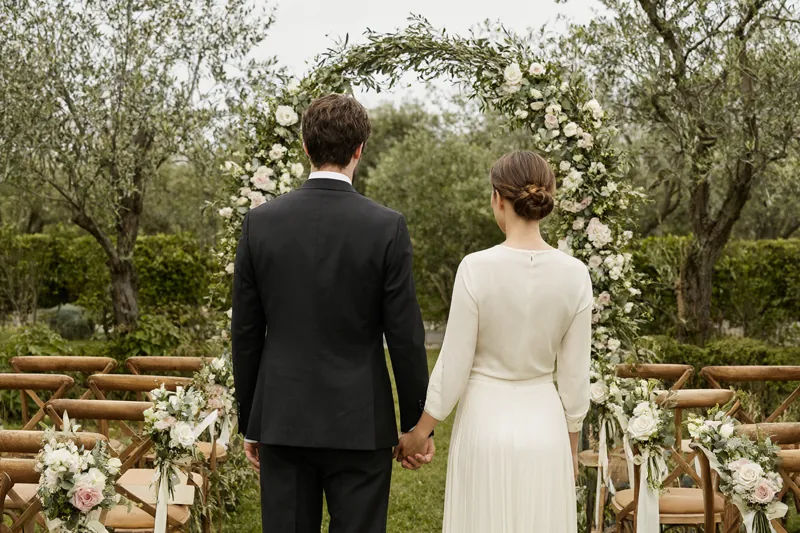
- for a symbolic ceremony you are free, but sun and wind have a big say: arch, aisle, seating. See flowers for a symbolic ceremony.
If you are planning from abroad, read about planning your flowers from abroad and learn a few Italian customs in our guide to Italian wedding traditions and flowers.
Questions to ask before you decide
- To the Comune: which documents do we need for our nationality? Is this venue authorised for civil weddings?
- To the consulate: do you issue the nulla osta? How long does it take and how long is it valid?
- To the venue: which ceremonies can take place here? Are there rules on flowers, candles and timings?
- To the florist: have you worked with this type of ceremony at this venue before?
To sum up
Choose the ceremony first, then talk to the Comune and the consulate: the rest follows. Many couples marry legally at home and enjoy a symbolic ceremony in Italy without constraints. Once date and place are confirmed, browse our florists for destination weddings or request a quote with your ceremony type, venue and guest count.
Sources
- Italian Civil Code, art. 116 (marriage of foreigners in Italy): Normattiva
- Law no. 76 of 20 May 2016 (civil unions): Normattiva
- Regulation (EU) 2016/1191 on the circulation of public documents: EUR-Lex
- Italian Ministry of Foreign Affairs and International Cooperation: esteri.it