In short
- An elopement is a wedding for two or close to it; a micro wedding has a small group of guests.
- Public places often need permits, both for the ceremony and for some professional photo shoots.
- The essential flowers are a bouquet, a buttonhole and a small set-up, easy to carry.
- In the budget, travel and minimum orders count for more than the number of flowers.
Marrying just the two of you on a lakeside terrace, in a Dolomites forest, in a small country church. More and more couples, Italian and international, choose to elope in Italy or plan a micro wedding. This guide starts with the place: where to elope, how to get there, permits, seasons and what it costs. Then it covers the flowers you really need. If you are looking for florists who also take on small weddings, see our list of florists for destination weddings in Italy.
Where to elope in Italy
Almost every Italian landscape works. A few examples, with what affects the logistics:
- lakes (Como, Garda, Maggiore): villas, terraces, boats. See our Lake Como guide;
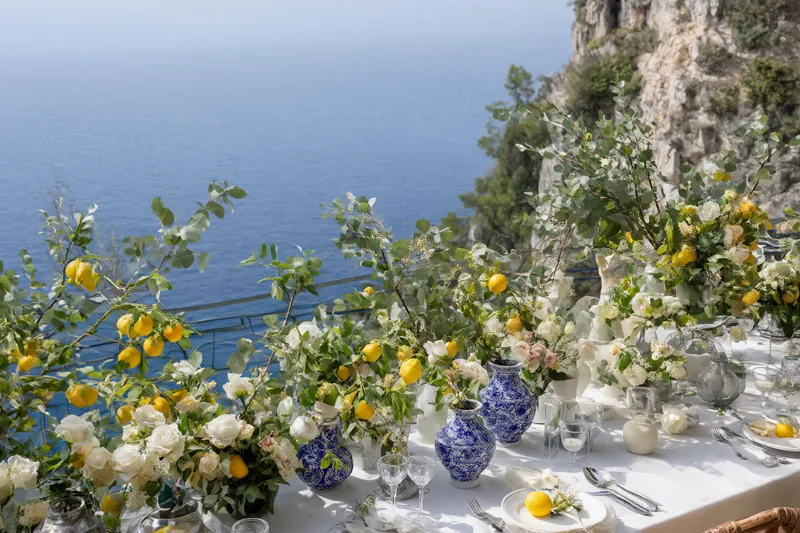
- the Amalfi Coast and islands: viewpoints, hotel terraces, steps and narrow access. See the Amalfi Coast;
- Tuscany and Umbria: hills, vineyards, villages, small country churches. See Tuscany;
- the mountains: meadows, mountain huts, alpine lakes. See the Dolomites;
- historic cities: Rome, Venice, Florence, with private terraces and courtyards.
The most photographed places are often crowded. Sunrise or a weekday changes everything.
Getting there and moving around
Each place has its own access. For Lake Como, guests usually fly into Milan or Bergamo; for the Amalfi Coast, into Naples; for Tuscany, into Florence or Pisa; for the Dolomites, into Venice, Verona or Innsbruck and then drive into the valleys. With only two of you, logistics are simpler, but a few things still matter:
- a private driver or a hired car makes sunrise and sunset sessions possible when public transport is not running;
- boats on the lakes and the coast need booking, and depend on the weather;
- mountain locations may involve cable cars with fixed timetables, or a walk;
- stay close to the ceremony spot the night before, especially for an early start.
Elopement or micro wedding: what changes
| Elopement | Micro wedding | |
|---|---|---|
| People | The couple, sometimes two witnesses | A small group of guests |
| Ceremony | Often symbolic, short | Civil, religious or symbolic |
| Afterwards | Photos, dinner for two | Lunch or dinner together |
| Flowers | Bouquet, buttonhole, sometimes a backdrop | Also centrepieces and table |
| Planning | Light, but logistics matter | Like a wedding, on a small scale |
If you want your marriage to be legally binding, civil and religious ceremonies have their own rules on places and documents. Many international couples marry legally at home and choose a symbolic ceremony in Italy. The overview is in our guide to getting married in Italy as a foreigner.
Permits for ceremonies and photos
A beautiful place is not automatically a free one. Before you decide:
- private places (villas, hotels, private land, managed beaches): you need permission from the owner or operator;
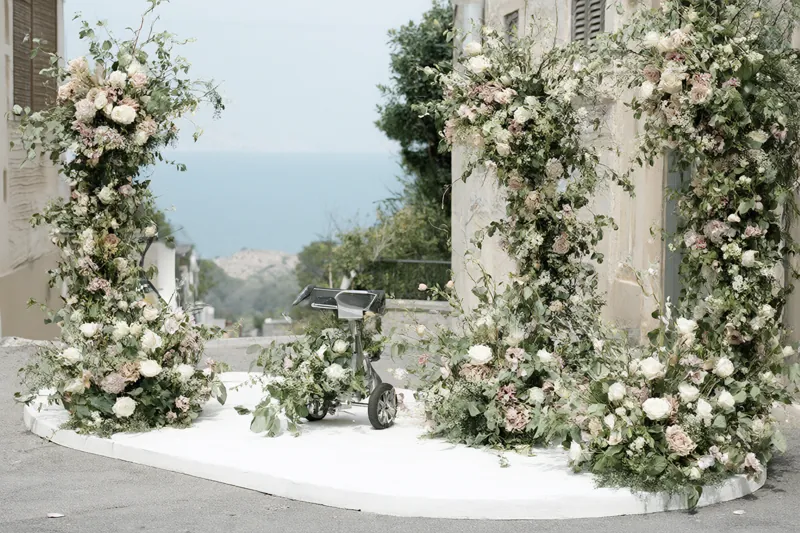
- public places (squares, parks, viewpoints, public beaches): even a small ceremony may need a permit from the Comune or the body managing the area, especially if you set up chairs, arches or flowers;
- monuments, museums and archaeological sites: professional photo shoots often have their own rules and authorisations;
- protected areas and nature parks: there may be limits on access, picking plants and decorations;
- churches: the parish decides whether and when to celebrate, even for small ceremonies;
- drones: flying is governed by national rules and many areas are banned or restricted. Your photographer must know them.
Each Comune and each authority has its own rules, and they vary from place to place. Ask whoever manages the space directly, or rely on a planner or photographer who works there often.
Season and timing
With so few guests you can choose dates and times a large wedding cannot. It is one of the advantages of eloping, and it changes the flowers too.
- Low season. Early spring and late autumn bring fewer crowds at famous spots and more supplier availability. Some venues and hotels close in winter: check first.
- Weekdays. A Tuesday in a village is very different from a Saturday in August, for crowds, parking and permits. Note that much of Italy slows down around mid-August holidays.
- Sunrise and sunset. Photographers' favourite times. At sunrise, though, the florist has to deliver very early, which may cost extra.
- Heat and wind. In summer in the South or by the sea, flowers suffer in the middle of the day. In the mountains it can be cold even in summer, and the weather changes fast.
To see what is available in your month, read our guide to seasonal flowers in Italy.
What an elopement in Italy costs
An elopement costs far less than a wedding with guests, but it is not free of fixed costs. The usual items are a photographer, a celebrant or the town hall fee, permits or a venue fee for the ceremony spot, hair and make-up, flowers, transport and a dinner. Famous locations, private villas, boats and peak-season Saturdays push every item up. For how each item is priced, and how the budget grows from 30 guests upwards, read how much a wedding in Italy costs.
Flowers
As an indicative range, a bridal bouquet in Italy usually costs from about €100 to €400, a buttonhole from €15 to €45, and a small arrangement for a ceremony table from €80 to €450, before VAT and without long-distance travel. In the best-known destinations, such as the lakes, the Amalfi Coast, Capri and Venice, expect the upper part of these ranges. For a small order, think in terms of items:
| Item | What moves it |
|---|---|
| Bouquet | Chosen flowers, size, season |
| Buttonhole | Little, but often charged separately |
| Small set-up | Number of pieces, hire of vases or structures |
| Travel | Distance, difficult access, boats, sunrise timings |
| Set-up and collection | Whether the florist stays or comes back to clear up |
| Minimum order | Some apply it even to a single bouquet |
A florist based in the area usually costs less than one who has to travel. Prices are in euros and normally subject to VAT (IVA). To understand the items in a quote, read how to read a florist's quote, and for ideas on saving, how to save on wedding flowers.
The essential flowers
With so few people, flowers are seen mostly in photos and close up. A few carefully made pieces are better.
Bouquet and buttonhole
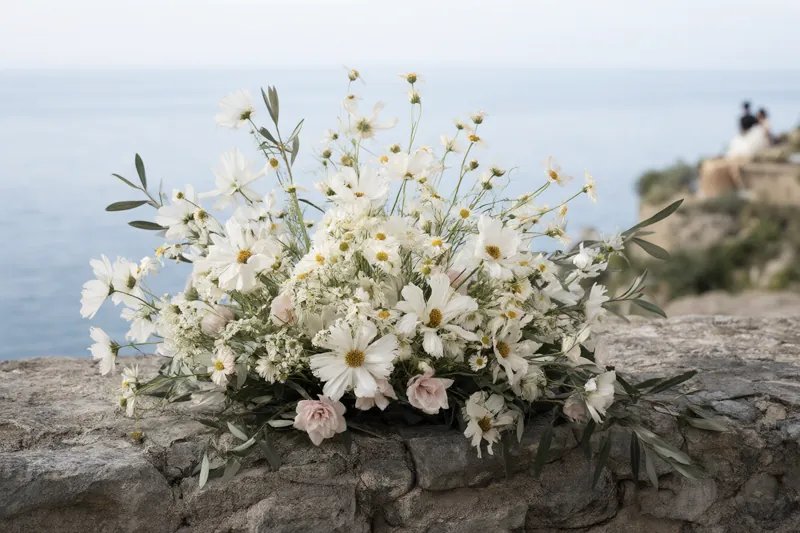
The bouquet is the main piece. It must look good from every side and last through hours of photos, often outdoors. Ask for flowers that cope with summer heat, or with wind at altitude or by the sea. For shapes, read our guide to bridal bouquet styles; for the buttonhole, the one on flowers for the groom.
A small set-up
If there is a ceremony, this is often enough:
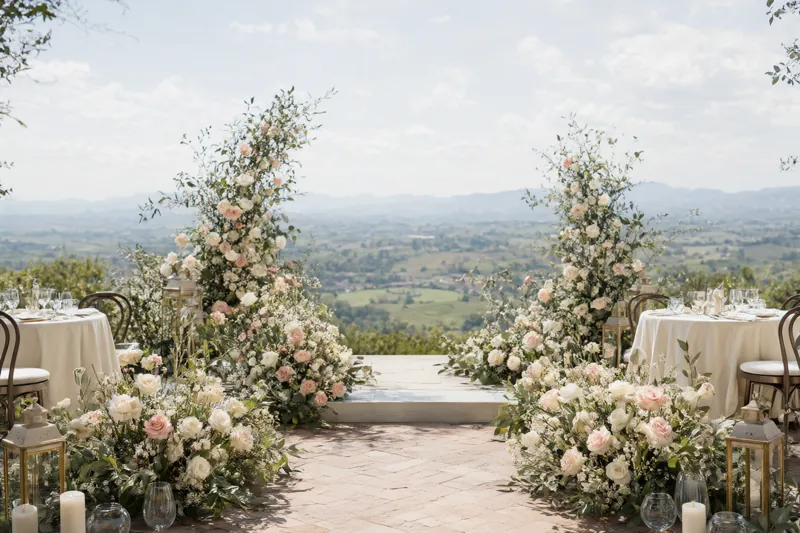
- one floor arrangement, or two either side, instead of an arch;
- a mini arch or light structure, if the place allows it;
- a few vases on a small table for the vows;
- a centrepiece for dinner, if there is one.
In many public and natural places, petals and confetti are not allowed or must be cleared up immediately. Leave the place as you found it.
Transport
The bouquet travels with you: on a boat, on foot along a trail, by car. Ask for a water container and a box to carry it. If the place is far from the florist's studio, ask whether they deliver to your hotel or meet you on site.
Micro weddings: a little more to think about
With a small group of guests you add a table and perhaps drinks. A single long table is often the heart of the party: a low garland of greenery and flowers works well and lets everyone see each other. Read our centrepiece ideas. If dinner is outdoors, check candles with the venue and keep a rain plan ready.
Planning from abroad
Many couples who elope live abroad. With a florist, one video call, a mood board with a few images and a clear quote are often enough. Our guide to planning your flowers from abroad explains how to do it well.
Questions to ask your florist
- Do you take on small weddings? Do you have a minimum order?
- Do you deliver to our hotel or meet us on site? At what time?
- Do you know the place and its rules on flowers and petals?
- Which flowers cope best with sun, wind or cold at that time of year?
- How do we carry the bouquet if we move around during the day?
- What happens in bad weather?
To sum up
An elopement is small, not improvised: place, permits and timing matter as much as flowers. Choose where first, check with whoever manages the space, then look for a florist in the area. For the full picture of a wedding in Italy, read our destination wedding guide.
You can browse our florists for destination weddings, see who looks after symbolic weddings and vow renewals, or request a quote with place, date and number of people.
Sources
- Italian Civil Aviation Authority (ENAC), drone rules: enac.gov.it
- Italian Ministry of Culture: cultura.gov.it