In short
- Minimalism uses few flowers, one variety or one colour, and leaves empty space.
- It works in modern architecture, museums, bare churches and contemporary terraces.
- Fewer flowers does not mean less care: every stem must be perfect and well lit.
- The budget shifts from quantity to the quality of flowers, vases and light.
"Less is more" is a phrase you hear a lot. With flowers it is only true if there is a design behind it. This guide to minimalist wedding flowers is for couples who love clean spaces and essential arrangements and want to understand how to build a minimalist floral design that does not look bare, where it works and what to ask your florist.
What minimalist means
You can recognise a minimalist design by three things:
- Few elements. One arrangement instead of three, a branch instead of a bunch.
- A strong choice. One flower, one colour, one shape repeated.
- Empty space as part of the design. The bare tablecloth, the clear wall, the distance between one vase and the next.
Minimalist does not mean "no flowers". It is a way of giving value to every flower you use. To find florists who work in this language, start from our list of wedding florists in Italy and look at their portfolios: those who do minimalism well often have very different projects, but always clean ones.
Variations on minimalism
| Variation | How it looks | When to choose it |
|---|---|---|
| Single flower | One variety, repeated | You want a clear, recognisable signature |
| Monochrome | Different varieties in the same colour | You want softness with order |
| Architectural | Branches, long stems, vertical lines | High spaces, galleries, bare churches |
| Ikebana and Japanese-inspired | Few stems, asymmetry, emptiness | Intimate weddings, symbolic ceremonies |
| Essential green and white | Selected foliage and a few white flowers | Venues already rich in detail |
Flowers that suit minimalism
Flowers with a clean shape, one you can read from a distance, work best:
- calla lilies: clean lines, classic elegance;
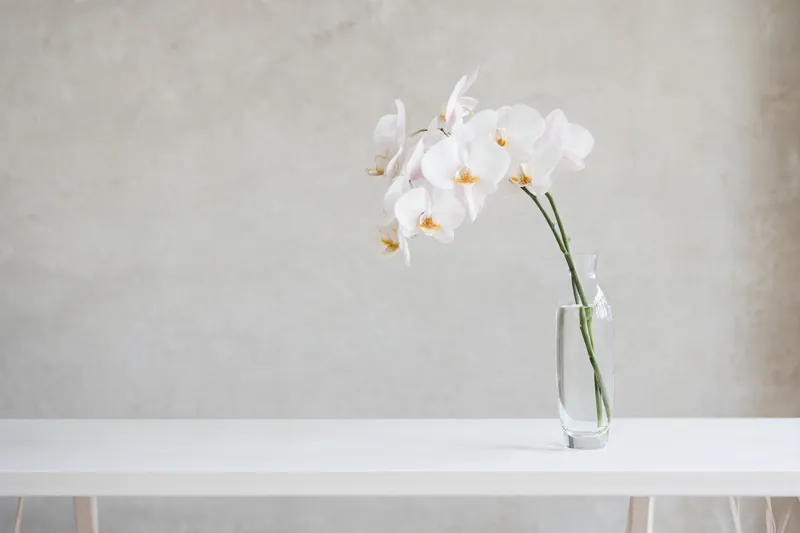
- orchids: sculptural shapes, good staying power;
- anthuriums: modern, graphic;
- tulips: in spring, soft but orderly;
- poppies and anemones: for a more poetic minimalism;
- flowering branches: cherry, almond and peach in late winter and spring;
- a single garden rose in a small vase at each place setting.
Availability changes with the season. For a month-by-month picture, read our guide to seasonal flowers in Italy.
Where it works best
- Modern and industrial architecture: concrete, glass, steel. Minimalism respects them.
- Museums and galleries: they often have strict rules on what can be placed. A few arrangements are easier to get approved.
- Bare or Romanesque churches: bare stone and simple lines go well with essential arrangements.
- City terraces: with a view over the city, the flowers should not compete with the panorama.
- Civil weddings and intimate ceremonies: the wedding room at the town hall does not always leave space for large set-ups. Read our guide to flowers for a civil wedding at the town hall.
It works less well in large banquet halls with many round tables, where it can get lost.
The role of vases and light
In minimalism the container matters as much as the flower. Clear glass, matte ceramic, metal, design vases. Some florists have their own collection for hire. Ask to see it.
Light is the other decisive element. An essential arrangement in a dark room disappears. Candles, spotlights or natural light make the difference. Read our guides to lighting and flowers and to hiring vases and structures.
Minimalism on the table
The table is where minimalism works best, because it leaves room for plates, glasses and conversation.
- Single bud vases spread along a long banquet table, with one or three stems each.
- One low arrangement in the centre of a round table.
- A branch laid on the tablecloth next to the candles.
- A flower on each guest's napkin.
Watch out: many small vases mean a lot of work to place and collect them. Make sure it is in the quote. To coordinate the table, read our guide to table settings and flowers.
Minimalism at the ceremony
In church, minimalism respects the architecture and lets the space speak. Two arrangements on either side of the altar and a touch at the entrance can be enough, or a single flower tied to the pews at the back of the nave. Before deciding, ask the parish priest what can be placed and where: some Italian churches have precise rules about the altar and the sanctuary area. Read our guide to church flower decorations.
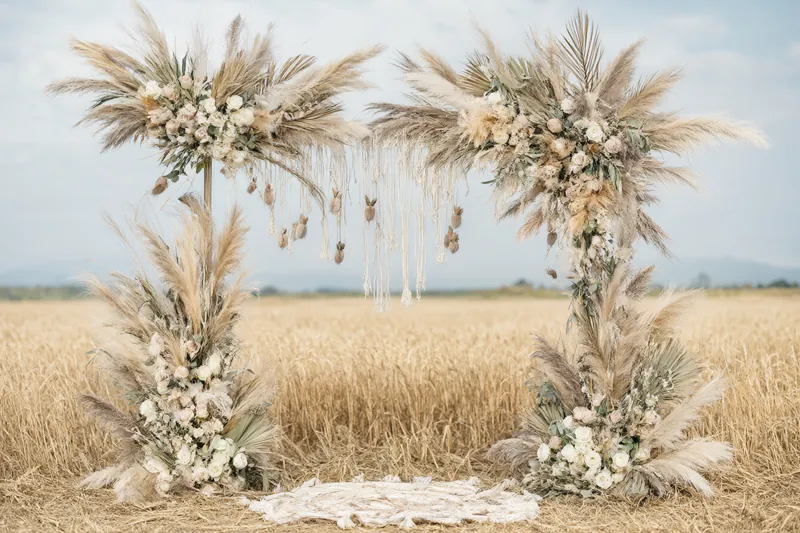
For a civil or symbolic ceremony outdoors, minimalism often becomes a light structure (a hoop, two columns, a slim frame) with a few flowers in one spot, instead of the classic full arch.
The minimalist bouquet
The minimalist bouquet is often small or elongated: a few calla lilies tied with a silk ribbon, a bunch of tulips in one colour, a single orchid, a flowering branch. It works well with clean-lined dresses without much embroidery. Watch the proportions: a very small bouquet with a very full dress can disappear in photos. For more ideas, read our guide to bridal bouquet styles.
Budget: where the money goes
Minimalism shifts the budget; it does not always reduce it.
- Fewer stems, so the flower cost is often lower.
- High-quality flowers: every flaw shows.
- Design vases and stands, hired or bought.
- Dedicated lighting to show off the arrangements.
- Design time: deciding where to place a few elements takes thought.
For an overview of cost items, read our guide to how much wedding flowers cost.
Common mistakes
- Confusing minimalist with cheap. You save if the design allows it, not by definition.
- Choosing a fragile flower. If there is only one type of flower and it suffers in the heat, the whole design suffers.
- Forgetting scale. In a hall with very high ceilings, small vases vanish. You need vertical elements.
- Adding things at the last minute. Minimalism is spoiled by additions made "just in case".
Minimalism at corporate events
The minimalist style is also widely used beyond weddings: corporate dinners, product launches, openings, exhibitions. Here it has a practical advantage: a few clear arrangements do not hide the brand, the speakers or the products on display, and they are quick to set up. Often a colour close to the company's is chosen and the same element is repeated in every space. The same rules apply to weddings: one strong element, repeated consistently, is more memorable than many different arrangements.
Questions to ask your florist
- Which flower or which colour would you choose for my venue?
- Do you have design vases and stands for hire? Can I see them?
- How do you light the arrangements in the evening?
- How many arrangements are really needed so the effect does not look bare?
- Can you prepare a sample centrepiece?
To sum up
Minimalism is one of the hardest styles to do well, precisely because it looks simple. It rewards you with an elegant, clean design that is often easier to manage on set-up timings. Compare it with the other options in our guide to wedding flower styles.
Once you have chosen your venue and date, request a quote and ask for a proposal with flowers, vases and lighting listed separately.