In short
- The floor plan decides how many centrepieces you need and what shape they take: draw it before you finalise the flowers.
- Round tables: one centrepiece each. Long banquet tables: you work in metres. U-shape: flowers on the outer side, centre kept clear.
- Centrepieces must leave sight lines and space for plates, glasses, bottles and service.
- Every change to the plan goes to your florist and caterer together.
Your wedding table layout and your flowers are planned together. The shape of the tables decides how many centrepieces you need, how much room they have and how much they add to the budget. The flowers, in turn, can change how the room feels. This guide is for couples drawing up the reception layout who want to avoid surprises: centrepieces too wide, extra tables nobody counted, blocked routes. If you are looking for someone to handle all the floral design, start with our list of wedding florists and floral designers.
Table shapes and flowers
| Shape | Approximate seats | Typical centrepiece | Watch out for |
|---|---|---|---|
| Round | 8-12 | One arrangement in the middle, low or tall | Sight lines between guests opposite |
| Rectangular | 6-10 | One low elongated arrangement or two small ones | Room for platters and bottles |
| Long banquet (imperial) | 20-60 and more | Garland or repeated low arrangements, candles | Narrow width, service from both sides |
| U-shape (horseshoe) | Depends on the modules | Flowers on the outer or front side | The centre stays free for service |
| High cocktail tables | Standing | Small vases or nothing | Stability, room for a glass |
| Top table | 2 or more | Front-facing or long arrangement | Not hiding the couple in photos |
Seat numbers are approximate: they depend on the real size of the tables, which comes from the caterer or the venue. Always ask for it.
Round tables
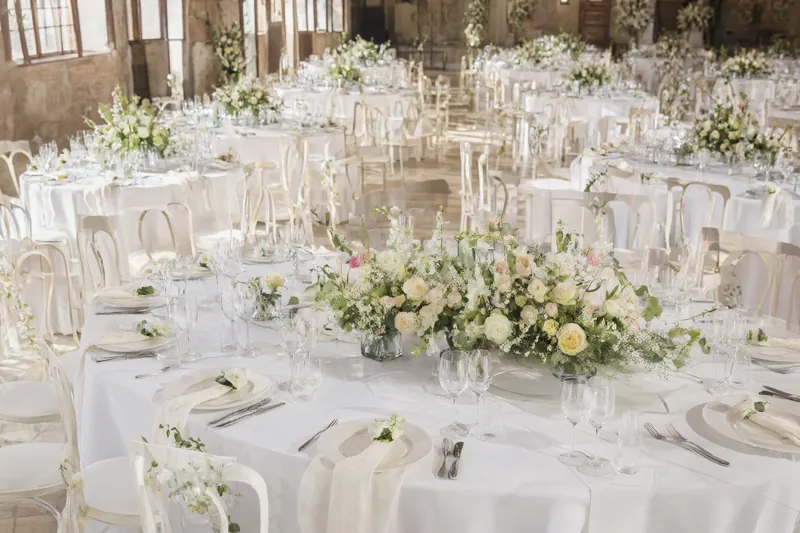
They are the most common choice at Italian receptions. For flowers they are the easiest to calculate: one centrepiece per table. You can vary the height, with tall arrangements on some tables and low ones on others, to give the room movement without doubling the cost.
On a large round table a tall centrepiece works well, because it leaves the view clear below the arrangement. On a small table, a tall and heavy one looks out of proportion and takes up space. Remember that Italian caterers often put bread, water, wine and sometimes platters in the middle of the table: ask how much space is left.
For centrepiece ideas, read our guide to wedding centrepiece ideas.
Long banquet tables
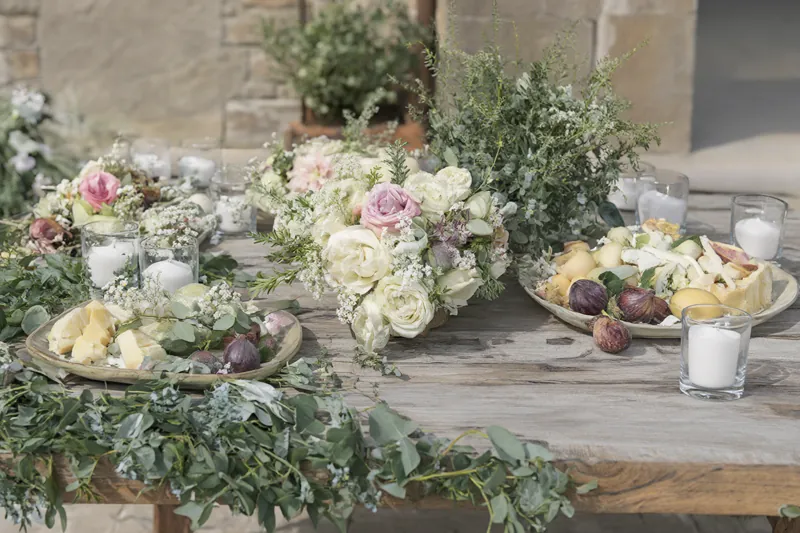
The long table, which Italians call the "imperial" table, is much loved in masserie (the farmhouses of Puglia), country houses, under pergolas and in the old lemon houses of the lakes and the south. For flowers it means thinking in metres, not pieces.
Two common solutions:
- a continuous garland of greenery with flowers tucked in, running the whole length;
- repeated low arrangements, alternating with candles and bottles.
Limits to know:
- a banquet table is usually narrower than a round one, so the flowers must stay low and slim;
- service happens from both sides and the caterer must be able to set down serving dishes and bottles;
- a full garland over many metres takes a lot of material: ask for a price per metre and decide whether to break it up.
If the table is outdoors, the wind moves light branches and blows out candles. Ask for arrangements with heavy bases.
U-shape and head table
The U-shaped layout turns everyone towards one point: a head table, a stage, a screen. It is more common at corporate events than at weddings. The flowers go on the outer side or along the front, never in the middle of the U, which is needed for service. At events with speakers, arrangements must be low so they do not hide whoever is talking. Find out more in our guide to corporate event flowers.
The top table
It can be a separate table, a sweetheart table for two, or a long table with family and witnesses. Either way it is the most photographed table of the day. The front arrangement should be generous but must not hide the couple when they are seated. Read our guide to top table flowers.
How many centrepieces: the calculation
- Count the tables on the plan, including the top table and any children's tables.
- Add the spare table, if the caterer plans one: it usually stays empty, but if it is used it needs a centrepiece. Ask your florist whether to keep one extra ready.
- For banquet tables, multiply the metres by the chosen solution: a continuous garland or a set number of arrangements per metre.
- Add the spots away from the tables: buffet, bar, seating plan, restrooms, confetti table (the Italian sugared-almond table).
- Subtract what is reused from the ceremony: altar or pew arrangements that move to the reception.
A rough example: 100 guests on round tables of 10 means 10 tables plus the top table. With tables of 8 it becomes 12 or 13. Two extra tables mean two extra centrepieces: that is why the shape should be decided early.
Service routes and flowers
Before the flowers, look at the routes:
- from the kitchen to the dining area: no floor arrangements, pedestals or large vases along the waiters' route;
- from the tables to the restrooms and exits: emergency exits always stay clear, according to the venue's safety plan;
- towards the buffet and the bar: arrangements on buffet tables must not get in the way of guests serving themselves;
- around the top table: the space in front is needed for toasts, speeches and photos.
A common mistake is the floor arrangement that looks lovely on paper and then everyone trips over it. Ask the caterer and the venue for a scale plan with the walkways marked.
Linen, plates and space on the table
The centrepiece shares the table with the place settings. Before fixing sizes, ask the caterer:
- how many glasses there are per setting;
- whether there are charger plates, place cards, menus;
- where bread, water and wine go;
- whether food is plated or served from platters, which take more room.
You will find more on all this in our guide to table settings and flowers.
Common mistakes to avoid
- Fixing the centrepieces before the floor plan: the number of tables almost always changes after guests reply.
- Forgetting the children's tables, or the suppliers' table if you decide to decorate it.
- Wide centrepieces on small tables: they take space from plates and glasses and make service difficult.
- Tall, light arrangements outdoors: the wind knocks them over. They need heavy bases.
- Very fragrant flowers on the table: strong scent can overpower the food and bother guests. Keep them for entrances and the ceremony.
- Candles without checking the rules: some venues ban them or allow them only in closed holders.
- Nobody moving the flowers from the ceremony to the tables: if reuse is planned, assign it to someone with a precise time.
Questions to ask your florist and caterer
- What shapes and sizes are your tables? How many people do you seat at each?
- Can you send me a scale plan with tables, walkways, buffet and bar?
- How much space is left in the middle of the table with your place settings?
- What maximum height do you suggest for the centrepieces?
- On the banquet table, a continuous garland or repeated arrangements? How much material per metre?
- Is there a spare table? Does it need a centrepiece too?
- Who places the centrepieces on the tables, and before or after the tables are laid?
- If the plan changes after guests reply, by when can I change the number of centrepieces?
To sum up
The right layout comes from three things: the shape of the room, the number of guests and the type of service. The flowers come straight after. Put your florist and caterer on the same floor plan, as our guide on getting flowers, catering and venue to work together explains. Once you have a draft plan, request a quote and attach it.