In short
- In Rome you can marry in historic churches, town hall rooms, palazzi, rooftop terraces and villas just outside the city.
- The centre has restricted traffic zones: deliveries and set-up need permits and planned timings.
- Churches and the Campidoglio have their own rules: always check before you design.
- In summer the heat on terraces is strong: heat-tolerant flowers and late installation.
A wedding in Rome is a popular choice for couples marrying in Italy from abroad, and for many Italian couples Rome is home. Churches from every era, historic civic halls, palazzi, rooftop terraces, villas along the Appian Way and in the Castelli Romani hills. This guide explains how flowers change in such a varied setting and what to ask. To see who works in the city and the region, open the list of floral designers in Rome and Lazio.
Typical Rome wedding venues
| Venue | What it offers | What affects the flowers |
|---|---|---|
| Historic church | Naves, chapels, works of art | Parish rules, tight timings, other services |
| Civic hall (Campidoglio and other sites) | Civil ceremony in a historic setting | A few minutes per room, limited decoration |
| Palazzo in the centre | Halls, courtyards, frescoes | ZTL, lifts and stairs, heritage protection |
| Rooftop terrace | Views over domes and rooftops | Sun, wind, access by service lift or stairs |
| Villa on the Appian Way or in the Castelli | Gardens, lawns, large spaces | Distances, traffic, landscape protection rules |
Rome is a city, and the city sets limits. The right florist knows the churches, the palazzi and the access routes.
Churches and basilicas
Many couples dream of a basilica, but the major basilicas have their own rules, often very restrictive on weddings and decorations. Smaller churches usually offer more possibilities.
The most common church rules:
- tight set-up times, sometimes with another service just before or after;
- no fixings on columns, altars or works of art;
- throwing petals or rice limited or banned on the church steps;
- in some cases sharing the decorations with another couple.
Ask the parish for its rules, in writing if you can, and pass them to your florist. Read church wedding flowers.
The Campidoglio and civic halls
For civil ceremonies Rome has historic municipal venues, the best known on the Capitoline Hill (Campidoglio). Ceremonies follow one another closely here, and floral decoration is usually very limited. Generally you bring the bouquet, sometimes a small agreed floral touch. Outside, in the square, the rules for public spaces apply.
Always check with the Comune (Rome's city council) office that manages ceremonies what is allowed. If you want a rich set-up, you can move it to the reception. Read flowers for a civil wedding at the town hall.
Restricted traffic zones and city-centre deliveries
Rome's historic centre has restricted traffic zones, known as ZTL (zona a traffico limitato). For suppliers this means:
- access permits or permitted hours;
- scarce parking for loading and unloading;
- narrow lanes that only small vehicles can use;
- traffic that stretches the time between church and reception.
ZTL rules and hours can change, so your florist must check them for your date. Ask for access to be covered in the quote. See extra costs in a floral set-up.
Terraces and palazzi
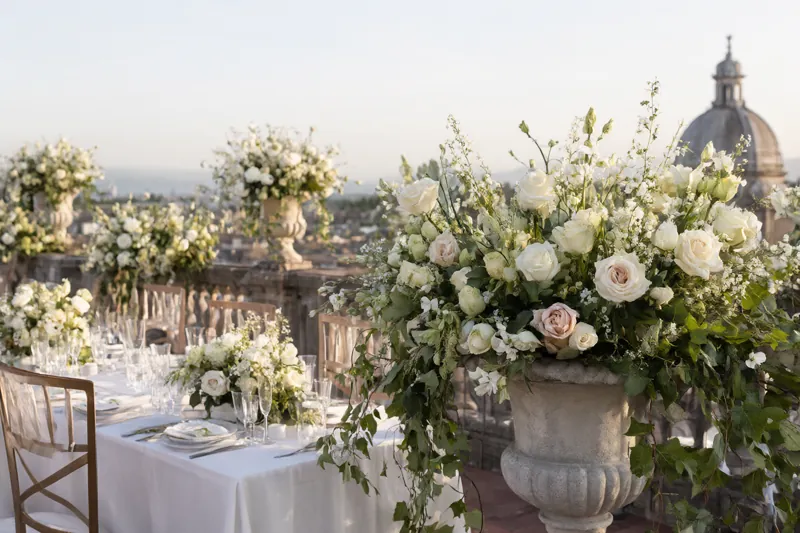
Rooftop terraces are very popular for aperitivo and dinner. For flowers:
- the sun beats down until evening in summer;
- wind at height knocks over tall, light arrangements;
- access is often by small lifts or stairs, so large structures must come apart;
- candles must be agreed with the venue.
In historic palazzi heritage rules apply: no nails, protected surfaces, set times. For candles, read flowers and candles.
Villas on the Appian Way and outside Rome
Outside the centre there are villas and farmhouses with large gardens: along the ancient Appian Way, in the Castelli Romani, in Sabina, towards the coast. There is space here, but other issues:
- distances and traffic between a church in the centre and a reception outside;
- protection rules in areas such as the Appia Antica park, which can limit structures and lighting;
- sun and wind on the lawns;
- who moves the flowers from church to villa.
Read set-up and breakdown.
Seasons in Rome
| Period | What to expect |
|---|---|
| April-May | Mild weather, city full of visitors, possible rain |
| June | Rising heat, long evenings |
| July-August | Strong heat even at night, many businesses closed in August |
| September-October | Warm light, pleasant weather, in high demand |
| November-March | Fewer weddings, churches and venues more available |
In summer choose heat-tolerant flowers and ask for installation close to the ceremony. Read flowers that cope with the heat.
Reusing flowers between church and reception
In Rome it is common to hold the ceremony in a city-centre church and the reception at a villa outside town. Moving the flowers seems a good way to save, and sometimes it is. But with traffic, ZTL and distances, the team has to take down quickly after the ceremony, load, cross the city and set up again before the guests arrive.
What moves easily:
- arrangements in vases or on stands, not fixed to the pews;
- bouquets and small table arrangements;
- potted plants.
What usually stays in church or is redone from scratch:
- pew and aisle decorations;
- large structures at the entrance;
- fixed or very delicate arrangements.
Ask your florist for a written plan, with timings and staff. Also read how to save on wedding flowers.
A winter wedding in Rome
Rome has fairly mild winters, and marrying between November and March has some advantages: churches and venues are more available, the city is quieter, and low warm light fills the palazzi. For flowers this means branches, greenery, berries, candles where allowed, greenhouse flowers and the first seasonal blooms towards the end of winter. Days are short, so bring the ceremony forward and take outdoor photos early. Read a winter wedding: flowers, greenery and lights.
Styles in Rome
Rome does not call for just one style. Classic, grand set-ups suit the palazzi; light, Mediterranean arrangements suit the terraces; garden or boho styles suit the villas. The city is the backdrop, and you decide the style with your florist. To find your way, read floral design styles.
Saturdays in church
In Rome's most popular churches there can be several weddings in a row on a Saturday. This cuts the time for set-up and breakdown, and sometimes leads couples to share decorations with another couple and split the cost. Ask the parish whether there are other ceremonies on your date and whether sharing is possible.
After the party
At villas outside the city, breakdown often happens at the end of the evening or the next morning. In palazzi and on terraces in the centre it is usually immediate, because the space must be cleared. Ask whether it is included, what time it happens and who collects vases and other hire items. If you want to leave flowers to the church or give them to guests, say so in advance. Read what to do with your flowers after the wedding.
Questions to ask your floral designer
- Do you know the church we have chosen and its rules?
- How do you handle the ZTL and loading in the centre?
- How long does it take to move the flowers from church to reception?
- How do you secure arrangements on a windy terrace?
- Which flowers do you suggest for a July wedding?
- Does the quote include permits, transport, set-up and breakdown?
- Who collects vases and hire items at the end of the evening?
Final thoughts
In Rome flowers have to live alongside churches, monuments and traffic. A florist who knows the city saves you time and surprises. If you are coming from abroad, read the complete guide to a destination wedding in Italy and working with a floral designer remotely.
Browse the floral designers in Rome and Lazio and, once you have a church and venue, request a quote.
Sources
- Roma Capitale, official website: www.comune.roma.it