In short
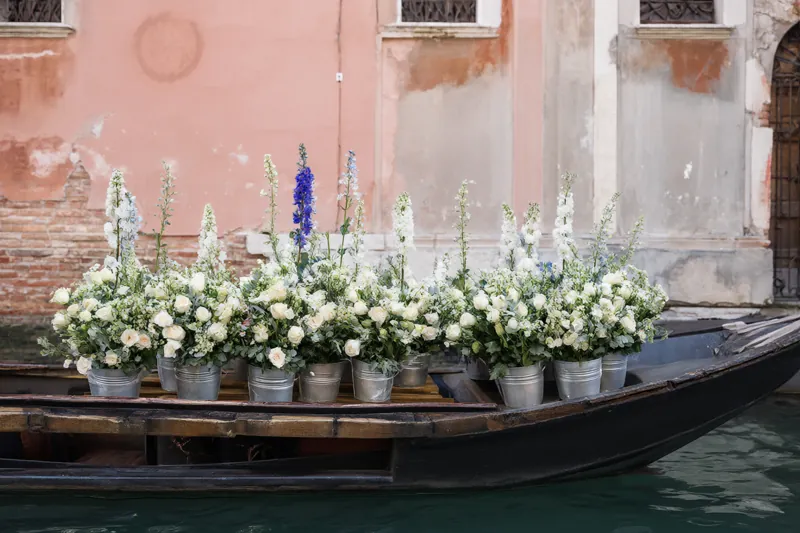
- In Venice everything travels by boat: flowers, vases, structures, people.
- The last stretch is often done by hand, through narrow streets and over stepped bridges.
- Palazzi and churches have heritage rules and set timings.
- In autumn and winter acqua alta (high tide) can change timings and routes.
A Venice wedding attracts many couples planning from abroad. Palazzi on the Grand Canal, churches, hidden gardens, islands in the lagoon. For flowers it is unlike any other city, because there are no roads for vans. This guide explains how it works and what to ask. To see who works in the city and the region, open the list of floral designers in Venice and the Veneto.
Typical Venice wedding venues
| Venue | What it offers | What affects the flowers |
|---|---|---|
| Palazzo on the Grand Canal | Halls, balconies, portego (grand central hall), water landing | Heritage protection, timings, access from the water |
| Historic hotel | Terraces, gardens, full service | Other guests, short set-up windows |
| Church | Art, naves, squares (campi) in front | Parish rules, access on foot |
| Civic venue for civil ceremonies | Ceremony in a historic building | Tight timings, limited decoration |
| Lagoon island | Gardens, cloisters, intimate spaces | Longer boat trips, weather |
Each venue has its own arrival route: from boat to door can be a few steps or a long walk through streets and over bridges.
Logistics on the water
This is the heart of it. A florist used to Venice organises:
- boat transport from the studio or from a loading point on the mainland;
- unloading at quays and landings, sometimes with set times and permits;
- trolleys for the last stretch, where stepped bridges slow everything down;
- more people to carry vases, water and structures;
- structures that come apart, because palazzo doors and stairs are narrow.
All this takes time. Set-up starts earlier and breakdown ends later. Ask for transport and porterage to be separate lines in the quote. See extra costs in a floral set-up.
Acqua alta
Acqua alta is a tidal phenomenon that in Venice occurs mainly between autumn and winter. It affects the lower parts of the city most. The lagoon's flood defences have reduced many episodes, but it is best not to take that for granted.
For flowers it means:
- deliveries rescheduled around the tide forecasts;
- walking routes that change;
- ground-floor palazzo floors that need protecting.
Ask your venue how it organises itself on high-tide days and ask your florist how much margin they leave in the timings.
Rules for palazzi, churches and public spaces
Venice is heavily protected, and there are many rules:
- in historic palazzi: no nails, protection under vases and water, care with antique floors;
- in churches: parish rules on timings, fixings and petals;
- in public spaces (squares and quaysides): Comune rules on use of the space, cleaning and decoration;
- candles and open flames according to the venue's rules.
Always check with whoever sets the rules: the venue, the parish, the Comune (the city council). On candles, read flowers and candles.
The civil ceremony
The Comune di Venezia holds civil weddings in historic buildings. As in many cities, ceremonies follow one another closely and decoration is limited. Usually you bring the bouquet and a few agreed touches. Ask the Comune office that manages ceremonies. Read flowers for a civil wedding at the town hall.
Seasons
| Period | What to expect |
|---|---|
| April-June | Mild weather, very busy city |
| July-August | Humid heat, mosquitoes in the evening, many visitors |
| September-October | Soft light, pleasant weather |
| November-March | Fog, damp cold, possible acqua alta, fewer crowds |
The lagoon's humidity affects delicate flowers and paper. For the warm season read flowers that cope with the heat; for winter, winter flowers, greenery and lights.
Style and light
Venetian palazzi have strong colours, stucco and glass. Set-ups that work with the architecture often succeed: warm tones, tall arrangements in the halls, garlands along long tables. But the style is still yours, from classic to minimal. Light reflected off the water changes a lot between day and evening, so ask your florist how the set-up will look under evening lighting. Read lighting and flowers.
Small weddings and elopements
Venice is also a favourite for couples marrying alone or with a few guests. Here the flowers come down to a few pieces: the bouquet, a buttonhole, sometimes a small arrangement for the ceremony or a private dinner. Logistics still go by boat, but are simpler.
If the ceremony is symbolic and takes place in a public space, such as a square (campo) or quayside, you usually need permits. Check with the Comune before planning. Read eloping in Italy.
Flowers on the couple's boat
Arriving at the ceremony or reception by boat is a much-loved moment. If you want to decorate the boat:
- use small, light, well-fixed arrangements;
- avoid vases with loose water;
- keep the skipper's position and passageways clear;
- always ask permission from whoever runs the boat.
A detail matched to the bouquet is often enough. In the photos, the setting matters more than the quantity of flowers.
Flowers on the water: freshness and timing
Every extra step is time out of water for the flowers. A good florist prepares arrangements in the studio, with water sources, and loads them as late as possible. In summer the sun on the water heats things up fast, so arrangements stay covered during transport. Ask how they work and what time they plan to load.
When to book
Venice has a limited number of palazzi and spaces suited to weddings, and boat logistics mean transport and staff must be booked in good time too. For high season, from May to October, it pays to move early: first the venue, then straight away the florist, who needs to know the date, timings and arrival route. If you can choose, late spring and early autumn offer a good balance of weather, light and acqua alta risk. In winter the city is quieter and venues more available, but you need a plan for fog and tides. Read how far ahead to book your floral designer.
After the party
Clearing up in Venice means doing the route in reverse: trolleys, bridges, boat. Work often happens at night, because the palazzo must be cleared. Ask whether breakdown is included, what time it happens and who collects vases and other hire items. If you want to give flowers to guests, arrange containers in advance. Read what to do with your flowers after the wedding.
Questions to ask your floral designer
- Have you worked at this palazzo or church before?
- Where do you load the boat and where do you unload? How far is the walk?
- How many people do you bring for transport and set-up?
- How do you plan for acqua alta?
- Does the quote include the boat, porterage, permits and night-time breakdown?
- Will the structures fit through the palazzo's doors and up its stairs?
- Who collects vases and hire items, and when?
Final thoughts
In Venice a floral set-up is first of all a transport plan. The right florist knows the quays, bridges and tides as well as the flowers. If you are weighing up other northern destinations, read the guides to Lake Garda and Lake Como, or the complete guide to a destination wedding in Italy.
Browse the floral designers in Venice and the Veneto and, once you have a date and venue, request a quote.
Sources
- Comune di Venezia, official website: www.comune.venezia.it