In short
- Wedding flowers fall into three blocks: people, ceremony, reception.
- The examples below are sample plans, not packages: use them to build your own list of pieces.
- The budget goes where guests look longest: the tables and the ceremony backdrop.
- Reusing ceremony flowers at the reception is often the smartest choice.
When you ask for a floral quote, the first question is: what do you need? Many couples do not know yet, especially when planning a wedding in Italy from abroad. This guide shows four wedding floral design examples, sample plans each with its list of pieces and the choices that hold it together. They are not templates to copy, but starting points for writing your own list. For a church ceremony, you will find the professionals who decorate churches and ceremony spaces in our directory.
The three blocks of every wedding
| Block | Typical pieces | When they are seen |
|---|---|---|
| People | Bridal bouquet, buttonholes, corsages for the mothers, flowers for bridesmaids and page boys, hair flowers | Getting ready, ceremony, photos |
| Ceremony | Altar or arch, pews or rows of chairs, entrance, aisle, table for a civil ceremony | Half an hour or a little more |
| Reception | Centrepieces, top table, seating plan, buffet and bar, stations, cake | Several hours |
The ceremony is short but it is the most photographed moment. The reception lasts hours. That is why many florists suggest moving part of the ceremony flowers to the reception.
Example 1: classic, church and villa
Setting: Catholic ceremony in a town or village church, reception in a villa with a garden, served dinner, about 120 guests on round tables.
People
- a round or loose bridal bouquet, with seasonal flowers;
- buttonholes for the groom, witnesses and fathers;
- a corsage or small posy for the mothers.
Ceremony
- two arrangements on either side of the altar;
- pew-end decorations along the aisle, on alternate rows;
- an arrangement at the entrance or on the doorway, if the parish allows it.
Reception
- a centrepiece for every table, with alternating heights;
- a front arrangement for the top table;
- a floral seating plan at the garden entrance;
- flowers for the dessert buffet and the confetti table (in Italy, confetti are sugared almonds).
Key choices: in an Italian church the parish priest sets the rules on timing, fixings, petals and sharing decorations with other couples marrying the same day. The altar arrangements are useful again on the buffet at the reception.
Example 2: civil wedding in the city
Setting: civil ceremony in the town hall wedding room (in Italy, the Comune), lunch or dinner at a restaurant or on a terrace in the centre, about 50 guests.
People
- a compact bridal bouquet;
- buttonholes for the groom and witnesses.
Ceremony
- one or two arrangements on the ceremony table, if the room allows it;
- no fixed decorations: town hall rooms often host weddings back to back.
Reception
- low centrepieces on rectangular tables or one long banquet table;
- small vases for the bar counter;
- an arrangement at the restaurant entrance.
Key choices: tight timing and difficult access. Italian historic centres have limited traffic zones (ZTL) and set loading and unloading hours. Town hall rooms have rules on what you can bring and for how long: ask the registry office (ufficio di stato civile). Read more in our guide to civil wedding flowers at the town hall.
Example 3: destination wedding on a lake
Setting: a couple from abroad, symbolic ceremony in the garden of a lakeside villa, dinner on the terrace, about 80 guests, party with music until late.
People
- a bridal bouquet, often looser and more natural;
- buttonholes for the groom and witnesses;
- flowers for the bridesmaids.
Ceremony
- a floral arch or semicircle as a backdrop, with the lake behind;
- ground arrangements along the aisle;
- decorated chairs in the front row.
Reception
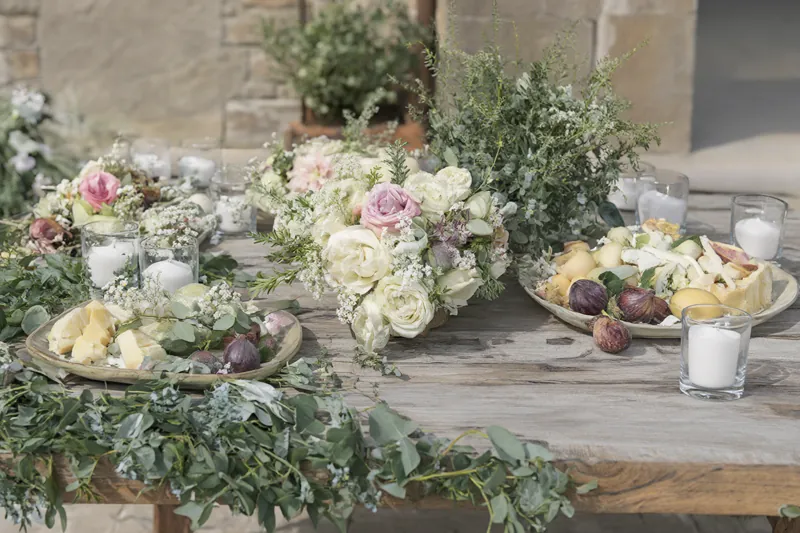
- a long banquet table with a garland of greenery and flowers, broken up by candles in closed holders;
- the top table built into the banquet table;
- a bar corner with tall arrangements;
- a lit photo corner for the evening.
Key choices: on the lakes the afternoon wind and the humidity matter. The arch must be weighted down. Historic villas often have precise rules on suppliers, timing and candles. Deliveries can take longer or need special transport, sometimes even by boat. Couple and florist work at a distance: read our guide on planning your flowers from abroad and browse our Lake Como wedding florists.
Example 4: boho in a masseria
Setting: symbolic or religious ceremony in a chapel, reception in a masseria (a fortified farmhouse) in the south of Italy, long drinks reception outdoors, dinner on banquet tables under the olive trees, about 150 guests.
People
- an asymmetric bridal bouquet with dried grasses and fresh flowers;
- buttonholes with wheat ears or herbs;
- flower crowns for the bridesmaids.
Ceremony
- an asymmetric ground arrangement or a semicircle of pampas and grasses;
- rugs and cushions in place of some chairs;
- an aisle lined with low arrangements.
Reception
- banquet tables with runners of Mediterranean greenery, olive branches and dried flowers;
- lanterns and candles, if the masseria allows them;
- a flower bar during drinks;
- a confetti table with dried flowers.
Key choices: heat and wind. Dried flowers and Mediterranean greenery cope with the sun better than many fresh flowers. Some dried grasses shed fragments and can bother guests with allergies. Browse our Puglia wedding florists.
The four examples side by side
| Classic | City civil | Lake | Boho masseria | |
|---|---|---|---|---|
| Approximate guests | 120 | 50 | 80 | 150 |
| Where the money goes | Centrepieces and church | Bouquet and table | Arch and banquet table | Banquet tables and ceremony |
| Main risk | Parish rules | Timing and access | Wind and logistics | Heat and wind |
| Possible reuse | Altar flowers on the buffet | Little | Arch in the photo corner | Ground arrangements at the bar |
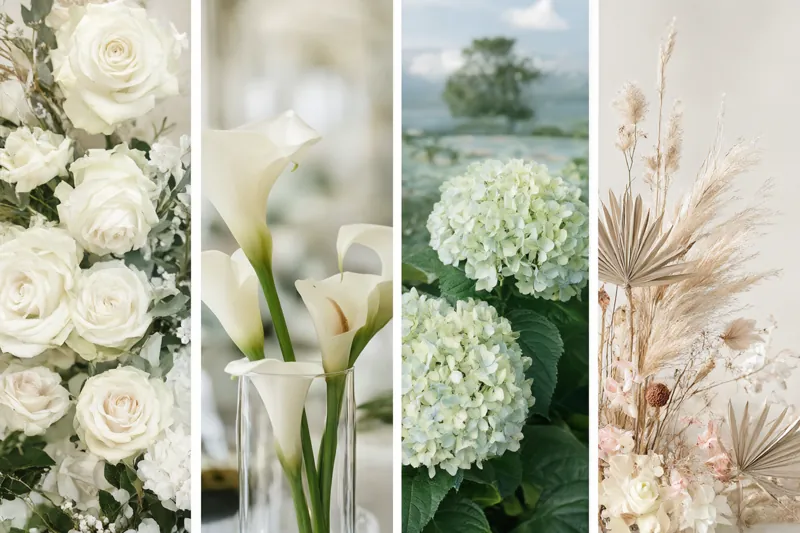
| Flower style | Roses, hydrangeas, seasonal flowers | Compact, single colour | Soft, pale tones | Grasses, dried flowers, greenery |
The styles shown are common examples, not rules: florists in every Italian region work in every style.
How to build your own list
- Start from the ceremony: religious, civil or symbolic. The rules and the ceremony pieces change.
- Count the tables on the floor plan, even a rough one.
- Choose where to concentrate the budget: two or three strong points, the rest simpler.
- Decide what is reused from the ceremony at the reception.
- Write the list and send the same one to several florists: that way the quotes can be compared.
To see how much each item costs, read our sample floral quotes.
How the season changes things
The same four examples change a lot with the month. In spring the classic villa wedding can count on ranunculus, peonies towards May and garden flowers. In high summer the boho masseria and the lake wedding have to deal with the heat: hardy flowers, set-up in the cooler hours, water in the containers. In autumn come dahlias, berries and coloured leaves. In winter greenery, branches and candles do much of the work. Always ask your florist what is good in your month before you fall for a photo.
Questions to ask your florist
- Looking at my list, what would you remove and what would you add?
- Where is it best to concentrate the budget at my venue?
- What can move from the ceremony to the reception? Who does it and how long does it take?
- Do you know the rules of the church, the town hall or the villa?
- Which seasonal flowers do you suggest for my month?
- Can you split the quote into people, ceremony and reception?
Getting started
Pick the example closest to your wedding, change what does not feel like you and turn it into a list. Then request a quote with your list of pieces attached.