In short
- In Puglia many weddings take place at a masseria, among ancient olive trees, pale stone and large open spaces.
- Heat and wind are the two things to manage: timings, heavy bases, sturdy flowers.
- Olive, citrus, bougainvillea and Mediterranean greenery are part of the landscape, but your style stays your own.
- Masserie are big: you need more pieces, or a few well-chosen focal points.
A Puglia wedding has become a popular choice for Italian and international couples alike. The Itria Valley, Salento, the coast between Bari and Monopoli, the Gargano: venues include fortified farmhouses (masserie), trulli (the round stone houses with cone roofs), seaside villas and olive groves. This guide explains how flowers work in this landscape, what to consider for the climate and what to ask. To see who works in the area, open the list of floral designers in Puglia.
Typical Puglia wedding venues
| Venue | What it offers | What affects the flowers |
|---|---|---|
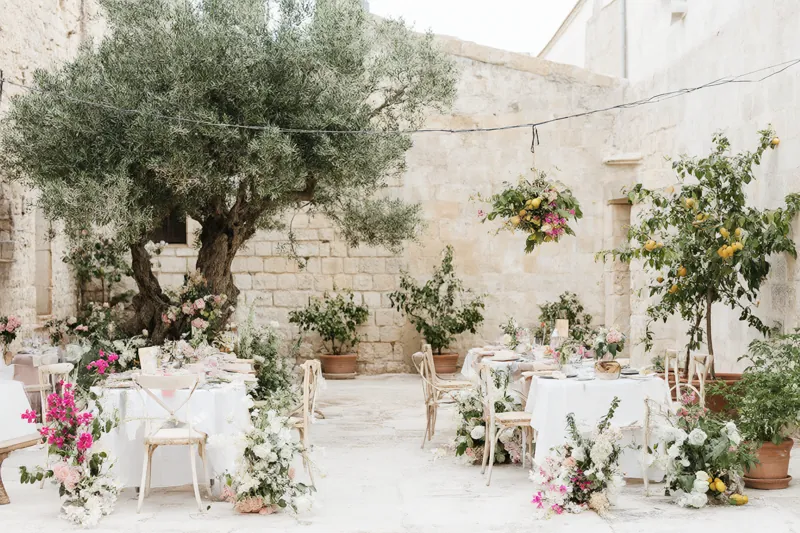
| Masseria | Stone courtyards, olive trees, pools, large lawns | Big spaces, full sun, wind |
| Trulli | Small rooms, cone roofs, gardens | Limited indoor space, narrow access |
| Seaside villa | Terraces, rocks, sunsets | Wind and salt air, little shade |
| Historic centre (Lecce, Ostuni, Polignano) | Baroque churches, squares, white lanes | Restricted traffic, carrying by hand |
| Olive grove | Long tables under the trees | Uneven ground, lighting needed after dark |
Pale stone and whitewashed walls reflect a lot of light. Strong colours stand out well, but neutral tones and greenery also work. For greenery ideas, read greenery in floral design.
Seasons in Puglia
These notes are general: they depend on the year and the area.
| Period | Climate | What you often find |
|---|---|---|
| May | Mild, sometimes windy | Roses, wildflowers, poppies in the fields, citrus in blossom in some areas |
| June | Warm, pleasant evenings | Roses, Mediterranean greenery, bougainvillea in flower |
| July-August | Very hot, crowded resorts | Sturdy flowers, greenery, succulents, olive |
| September-October | Heat easing, golden light | Dahlias, roses, pomegranates, figs, fruiting branches |
Bougainvillea colours many walls and pergolas in summer. It looks great where it grows, but it does not last long once cut: usually you make the most of what is already at the venue.
Heat: timings and flower choice
In summer the middle of the day is hard on flowers and people. In Puglia ceremonies often move to late afternoon, with dinner outdoors once the sun goes down. Ask your florist:
- which flowers will hold up on your date and at your time;
- how long the flowers stay outside before the ceremony;
- whether arrangements have water sources or tubes;
- where flowers are kept cool at the masseria.
Delicate flowers such as hydrangeas and peonies suffer in the sun. You can still use them, but in the shade or in arrangements with water. Read more in flowers that cope with the heat.
Wind
Wind is common, especially near the sea. It knocks over tall, light vases, blows petals and tablecloths away and ruffles arches. That is why:
- heavy bases and stable vases are preferred;
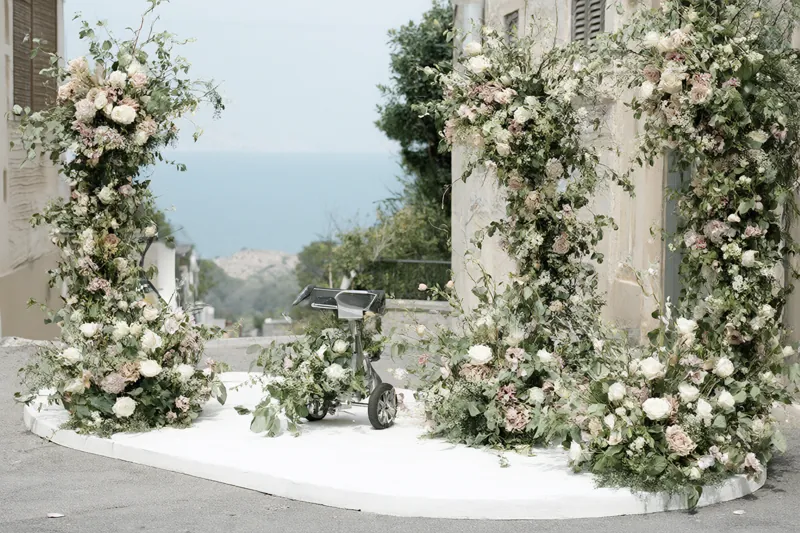
- arches and structures must be fixed or weighted;
- outdoor candles go in closed holders, if the venue allows them;
- petals on the ground can blow away before the ceremony.
Ask your florist how they secure structures. For ceremony backdrops, read floral arches and ceremony design.
Olive trees, citrus and southern greenery
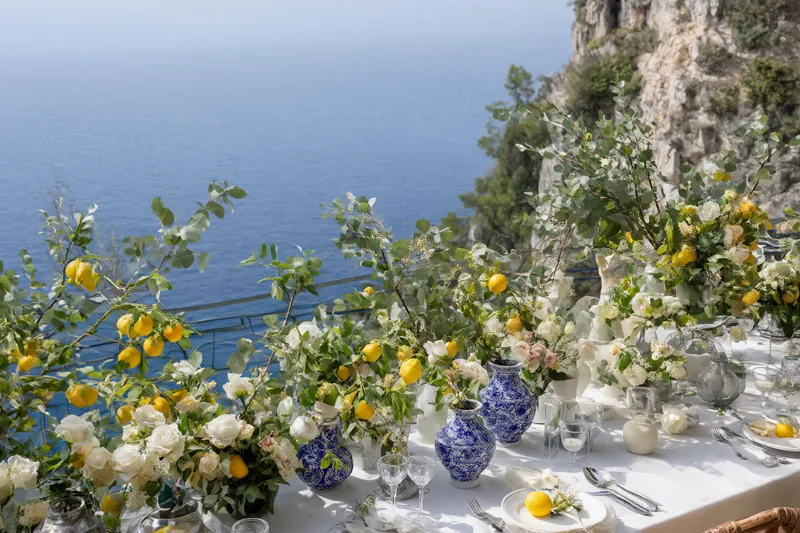
Ancient olive trees are the symbol of Puglia and often already form the scenery: you set the tables beneath them and light them. Potted citrus, fruiting branches, fig, pomegranate and aromatic herbs are materials many local florists use.
Two points to watch. Monumental olive trees are often protected: hanging lights or objects must be agreed with the owner. And real fruit on the table should be agreed with the caterer, because it sits near food. Read lemons, oranges and olive in wedding design and Mediterranean style.
In Puglia too, your style is free: there are masserie dressed in minimal, classic or very colourful ways. The region suggests, it does not impose.
Big spaces: how to fill them
A masseria has wide courtyards, lawns and terraces. Spread a few flowers everywhere and the effect gets lost. There are two approaches:
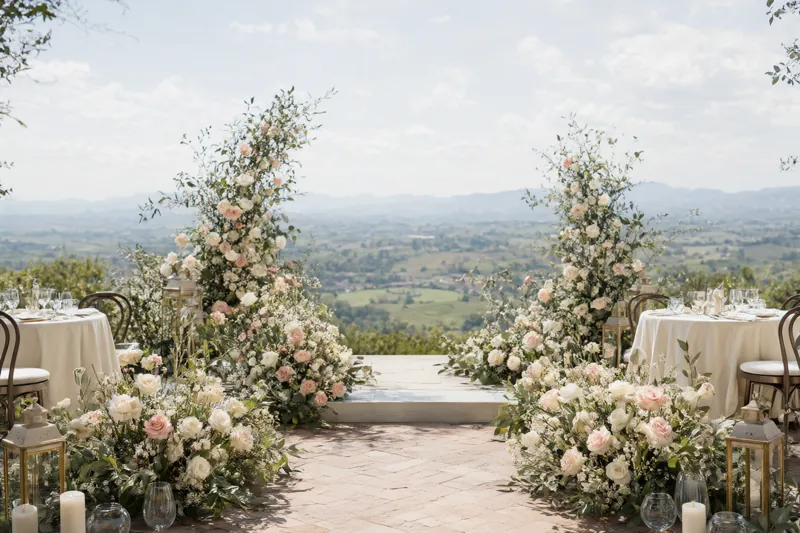
- A few strong scenes: the ceremony, the couple's table, the entrance. The rest with greenery and light.
- Repetition: the same element repeated on every table, to give rhythm.
Reusing the ceremony flowers at the reception often makes sense. Ask who moves them and when.
Where to put flowers at a masseria
Thinking in focal points helps you avoid spreading the budget too thin. Here is how a masseria set-up is often distributed, as a rough guide only:
| Spot | What is often done | Share of the budget |
|---|---|---|
| Entrance and gateway | Large arrangements, potted plants, olive trees | Medium |
| Ceremony | Arch or semicircle, aisle, seating | High |
| Aperitivo in the courtyard | Greenery, citrus, a few tall arrangements | Low |
| Dinner tables | Repeated centrepieces or garlands | High, rising with the number of tables |
| Couple's table | Front-facing or long arrangement | Medium |
| Confetti table and cake | Small matching arrangements | Low |
The confettata is very common in southern Italy: a table of confetti (sugared almonds, not paper) from which guests help themselves. If you are new to it, ask your florist to coordinate it with the rest. Read flowers and traditions of the Italian wedding.
Evening light and olive trees
At a masseria dinner often runs after sunset. At that point flowers are only visible if they are lit. Warm lights in the olive trees, candles on the tables where permitted, low spotlights on the main arrangements: these are choices to make with whoever handles lighting. A set-up that looks great by day can vanish in the dark. Ask to see evening photos of past work. Read lighting and flowers.
Travel and set-up
Masserie are often in the countryside, far from towns. Your florist may come from Bari, Lecce or from outside the region. Ask for travel, set-up and breakdown to be clear lines in the quote, and whether set-up can happen the day before. In peak months roads and towns are busy, so travel times need a margin.
If you are coming from abroad
Wedding celebrations in Puglia often last many hours, with a long dinner and the cake cut late at night. Table flowers must last until the small hours, even in the heat. If you are from abroad, ask your florist to explain local customs such as the confetti table and wedding favours (bomboniere), and decide together what to keep.
After the party
At a masseria the party often ends very late. Ask whether breakdown happens straight away or the next morning, and whether the venue has another event the following day. If you want to give the flowers to guests or leave them to the masseria, say so in advance: your florist will arrange containers and the collection of hired vases. Read what to do with your flowers after the wedding.
Questions to ask your floral designer
- Have you worked at this masseria before? Do you know its rules?
- Which flowers do you suggest for an outdoor wedding in July or August?
- How do you secure arches and arrangements against the wind?
- Can we put lights or decorations in the olive trees?
- Which materials will be local or from Puglia on our date?
- When do you set up, and who moves the flowers between ceremony and dinner?
- What is the plan if the wind is too strong for the outdoor set-up?
Final thoughts
In Puglia flowers have to cope with sun, wind and open spaces, but they have a strong landscape around them that helps. If you are comparing southern regions, read the guides to Sicily and the Amalfi Coast too.
Browse the floral designers in Puglia and, with your date and venue in hand, request a quote.