In short
- Tuscan weddings often take place in villas, hilltop villages and wine estates: big spaces, lots of light, mostly outdoors.
- May, June and September are the most popular months; in summer the heat decides timings and flower choice.
- Olive, cypress, herbs and wildflowers make up the landscape around you, but your style stays your own.
- In the countryside distances count: travel, set-up and breakdown must be spelled out in every quote, which is why costs vary so much.
A Tuscany wedding appeals to couples marrying in Italy from abroad, and the region is a favourite with Italian couples too. Chianti, Val d'Orcia, the hills around Florence, Lucca, Versilia, the Maremma: each area has its own landscape and its own venues. This guide starts with the place: the types of venue, how to get there, when to go and what a Tuscany wedding costs. Then it covers the flowers and what to ask your florist. If you want to see who works in the area, open the list of floral designers in Tuscany.
Typical Tuscany wedding venues
In Tuscany the venue drives the design more than elsewhere, because many weddings happen almost entirely outdoors.
| Venue | Strengths | What affects the flowers |
|---|---|---|
| Historic villa | Formal Italian gardens, halls, grand staircases | Rules on walls, frescoes and candles, tight time slots |
| Hilltop village (borgo) | Small squares, churches, stone lanes | Narrow access, loading and unloading by hand |
| Wine estate | Vine rows, cellars, long tables | Distances, full sun, uneven ground |
| Country farmhouse (casale) | Courtyards, pergolas, lawns | Wind, insects, little shade |
| City (Florence, Lucca, Siena) | Churches, palazzi, terraces | Restricted traffic zones (ZTL), vehicle permits |
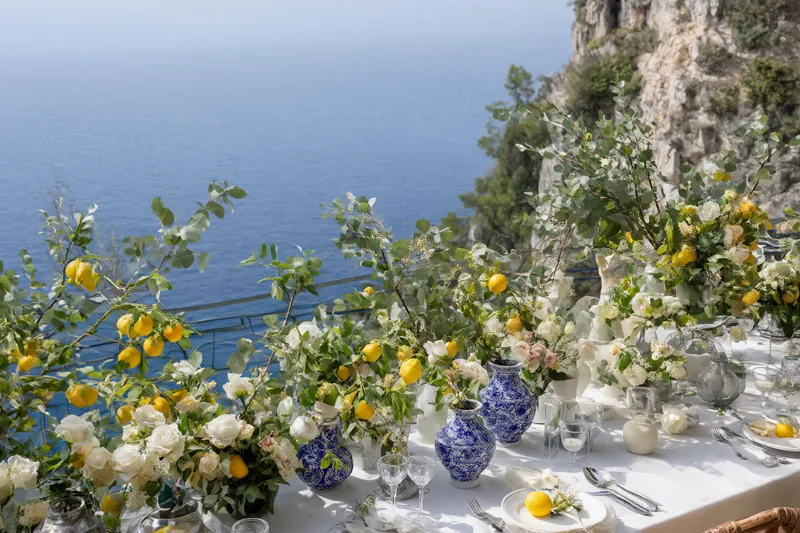
A long table under a pergola or between the vines is a much-loved scene. It works well with low garlands of greenery and flowers, bottles and candles, if the venue allows them. For table ideas, read wedding centrepieces.
Getting to Tuscany
Florence and Pisa have the closest airports, and many international guests also fly into Bologna or Rome and continue by train or car. From the airports, most countryside venues are reached by road: a hired car or a shuttle is almost always needed, because villas and estates are rarely served by public transport.
A few practical points for you and your guests:
- historic centres such as Florence, Siena and Lucca have restricted traffic zones (ZTL): hire cars and vans need a permit or must stay outside;
- gravel roads (strade bianche) lead to many farmhouses and estates, which matters for coaches and low cars;
- plan shuttles from the hotels to the venue, especially if guests stay in different villages;
- if the villa rents for several nights, many guests can stay on site and transfers become simpler.
Distances and country logistics
Many Tuscan venues are far from towns. A villa in Chianti or an estate in Val d'Orcia can be hours by van from your florist's studio. For your suppliers this affects:
- travel for the team, sometimes with an overnight stay;
- set-up, which may start the day before if the venue allows;
- breakdown late at night or the next morning;
- gravel roads (strade bianche) and narrow access for vans.
Ask for all of these to be written into the quote. The cost of a wedding in Tuscany varies a lot with these items, so get them itemised. The typical lines are explained in how to read a floral designer's quote.
Seasons in Tuscany
The notes below are a general guide. They depend on the year, the altitude and what your florist can source.
| Period | What to expect | Flowers and greenery often available |
|---|---|---|
| April-May | Bright green, cool nights, some rain | Ranunculus, roses, wildflowers, peonies towards May |
| June | Long light, first heat | Garden roses, hydrangeas, delphinium, herbs |
| July-August | Strong heat in the valleys, yellow fields | Hardy flowers, sunflowers, lavender, Mediterranean greenery |
| September-October | Grape harvest, golden light | Dahlias, roses, vine leaves and branches, berries |
The September grape harvest (vendemmia) is a much-loved time, but on wine estates it is also working time. Ask whether there are access limits or farm machinery noise on your date.
What a Tuscany wedding costs
The cost of a Tuscany wedding varies more than almost anywhere else in Italy, because the region holds everything from simple farmhouses to historic villas near Florence. Villas often rent for several nights, distant estates add travel for every supplier, and outdoor dinners need lighting, hire items and a rain plan. A farmhouse in spring or autumn and a villa near Florence on a June Saturday are very different budgets. For a breakdown by item, with sample budgets for 30, 80 and 150 guests and a section on the Tuscany wedding cost, read how much a wedding in Italy costs.
Flowers
There is no Tuscan price list for flowers. As a starting point, our guide to how much wedding flowers cost in Italy gives indicative national ranges: roughly €1,800 to €4,000 for 60 guests with a civil or symbolic ceremony at a villa, and €3,500 to €8,000 for 120 guests with a church ceremony and a villa reception. They are orientation figures, not quotes. Countryside venues often sit around the middle of these ranges; Florence and the best-known villas, like other destination hotspots, usually sit in the upper part.
Items that often come on top in Tuscany:
- travel and overnight stays for the florist's team when the venue is far from their studio;
- set-up the day before, if the villa allows it, and someone to look after the flowers overnight;
- long tables dressed with garlands, priced by the metre;
- hire of vases, candle holders, lanterns and potted plants;
- late breakdown or a return trip the next morning.
Ask for each of these as a separate line, so you can compare quotes properly.
A typical villa wedding day
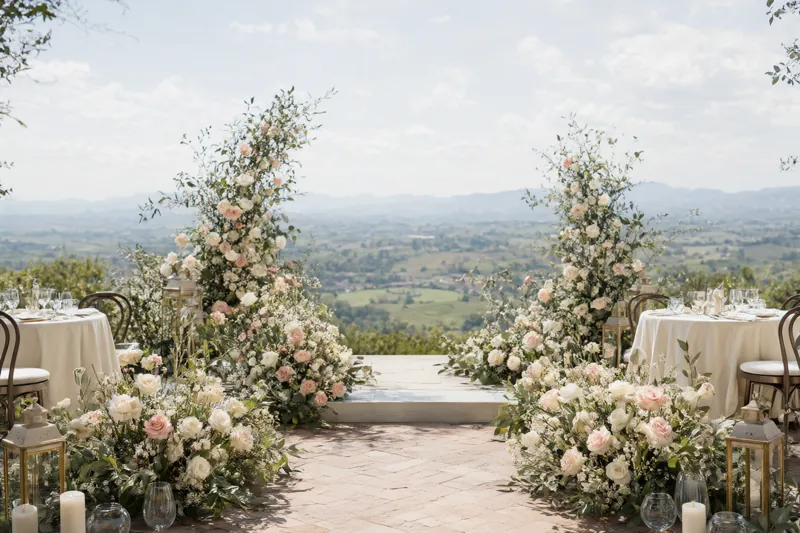
Many Tuscan weddings take place entirely at one venue: ceremony in the garden, aperitivo on the terrace, dinner under the pergola or on the lawn. This simplifies logistics and lets you reuse flowers. Here is an indicative example of how the work is spread:
| Moment | What happens to the flowers |
|---|---|
| Day before | Materials arrive, structures and hire items go up, if the villa allows |
| Morning | Ceremony and tables set up in the shade, bouquet delivered to the bride |
| Afternoon | Outdoor ceremony, when the sun is lower |
| Aperitivo | The team moves ceremony pieces towards the dinner |
| Evening | Candles and lights on, flowers on the tables |
| End of party or next morning | Breakdown and collection of vases and structures |
Ask your florist how many people they need for the move during the aperitivo: it is the tightest moment of the day. If ceremony and reception are in different places, for example the village church and a villa half an hour away, reuse becomes harder and you often need two separate set-ups.
Olive, cypress and countryside
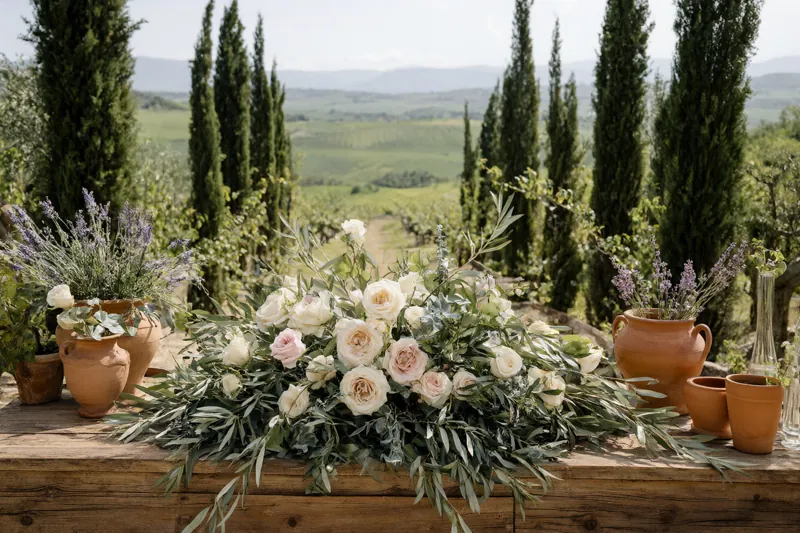
The Tuscan landscape offers materials florists often use: olive branches, aromatic herbs, wheat ears, wild greenery. Keep two things in mind.
- Not everything can be picked. Wildflowers and branches from someone else's fields or from protected areas are not free material. Your florist uses flowers that are grown, or gathered with permission. Read wildflowers at your wedding.
- The style is still yours. Olive and wildflowers are not compulsory. Tuscan weddings can be classic, minimal, romantic or modern. The countryside is the backdrop.
Tuscany also has an important nursery and flower-growing district between Pistoia and Pescia. This makes it easier to find potted plants and trees to hire. To learn where flowers come from, read Italian flower growing and markets.
Summer heat
In July and August the inland valleys stay hot even in the evening. Cut flowers suffer in direct sun and hot wind. Ask your florist:
- which flowers hold up best on your date;
- what time the ceremony is set up and how long the flowers sit in the sun;
- whether arrangements have water sources;
- where flowers are kept cool before installation.
Moving the ceremony to late afternoon often helps. There are more tips in flowers that cope with the heat.
Villa and church rules
Historic villas often have precise rules: no nails or tape on walls and frescoes, candles only in closed holders or LED only, fixed set-up hours, no petals in some areas. Village churches follow parish rules and often have other services on the same day.
Ask the venue and the parish for their rules in writing, and pass them to your florist. On candles, read flowers and candles.
Sunflowers and summer flowers
Sunflowers are one of the images most linked to Tuscany in summer. The fields bloom for a few weeks, usually in high summer, and change from year to year with what farmers plant. If you dream of photos among the sunflowers, do not build everything around that date: ask the venue what is sown nearby. As a cut flower, the sunflower copes well with heat and pairs with wheat, herbs and greenery. Read sunflowers at your wedding.
Rain plan
In spring and autumn a storm can change the day. Villas often have a hall or a limonaia (lemon house) as a fallback; farmhouses use marquees. Ask your florist which pieces move indoors and how quickly. See your rain plan.
Questions to ask your floral designer
- Have you worked at this villa or estate? Do you know its rules?
- Where does your team travel from, and what does travel cost?
- Which flowers will be grown in Tuscany or Italy on our date?
- Can you set up the day before? Who looks after the flowers overnight?
- How do you handle the heat for an outdoor afternoon ceremony?
- What is the plan for rain or wind?
- Do you use olive or vine branches? Where do they come from?
- Who clears up, and at what time?
Final thoughts
In Tuscany flowers work with the landscape: light, greenery, stone, vines. The key is a floral designer who knows the venues and the distances of the area. If you are still weighing up other regions, read the guide to a destination wedding in Italy or the one on Umbria.
Browse the floral designers in Tuscany and, once you have a date and venue, request a quote with your guest count and type of ceremony.