In short
- Choices tied to season, venue and light age well.
- Right now you see a lot of natural arrangements, abundant greenery, long tables and targeted installations.
- Very recognisable elements of a particular period work best as a detail, not as the base.
- A trend is fine if it works at your venue, not just in photos.
Every wedding season brings new images: an arch, a colour, a flower that is suddenly everywhere. This guide to wedding flower trends will not tell you what is "in this year". It tries to do something more useful: separate the ones that come from real changes in the way people work with flowers from those that may look dated in a few years, when you look back through your album.
How to read a trend
Before you fall in love with a photo, ask yourself three questions:
- Where does it come from? From a new way of using flowers (more natural, more sustainable) or from an object that keeps repeating?
- Does it work at my venue? An idea born in a barn does not always suit a historic palazzo.
- Would I like it even if I had not seen it everywhere? If the answer is yes, it will probably last, at least for you.
Looking at the work of several professionals helps you tell style from repetition. Start from the portfolios of our wedding florists in Italy.
What you see most
These are the directions that industry guides and florists' portfolios have shown most often in recent years. They are not rankings, just observed trends.
More natural arrangements
Fewer rigid shapes and perfect spheres, more loose stems, movement and asymmetry. This is the thinking behind the garden and wild styles. Read our guide to the romantic and garden style.
Seasonal flowers and attention to origin
More and more couples ask for flowers of the month and, where possible, flowers grown in Italy. It is a choice that brings together looks, budget and environment. See our guide to sustainable wedding flowers.
Greenery in the lead
Garlands of olive, eucalyptus, ivy and ferns. Greenery adds volume, copes better with heat and often costs less than premium flowers.
Long tables and garlands
The long banquet table (often called an imperial table in Italy), with garlands running down the centre, candles and small vases, has become a much-requested image, especially outdoors. Read our guide to wedding centrepieces.
Installations in a few spots
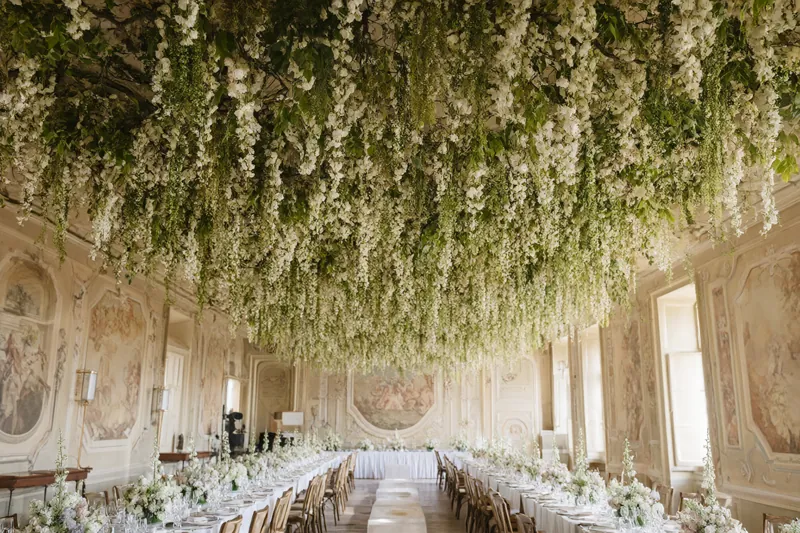
Instead of spreading flowers everywhere, the budget is concentrated in one or two strong points: an arch, a ceiling above the top table, an installation at the entrance. See our guide to hanging floral installations.
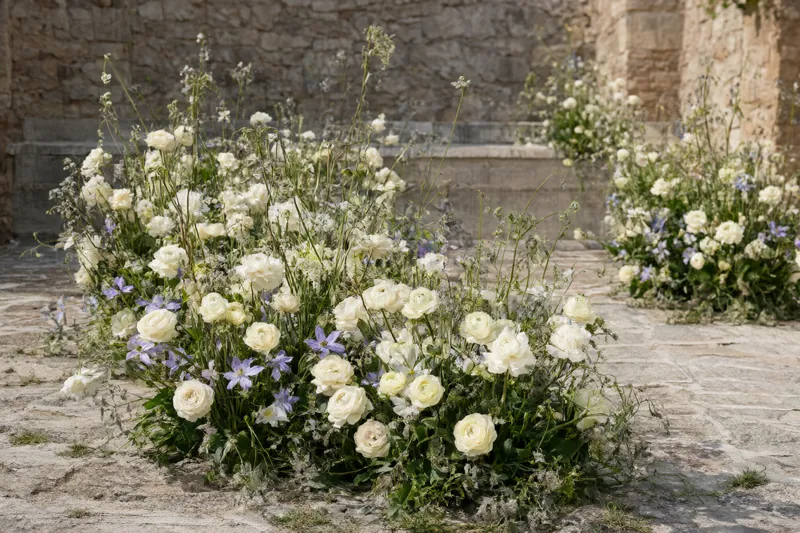
Flowers on the ground
Arrangements set on the floor along the aisle or at the base of the arch, as if the flowers were growing out of the ground. In an Italian church they must be agreed with the parish priest: they can get in the way.
What will last and what dates quickly
| Choice | Risk of looking dated | Why |
|---|---|---|
| Seasonal flowers that suit the venue | Low | They come from the place, not from a fashion |
| White and green, well-made classic arrangements | Low | A timeless language |
| Natural, airy arrangements | Low to medium | Now part of the common language |
| Olive garlands on long tables | Medium | Very widespread, but tied to the landscape |
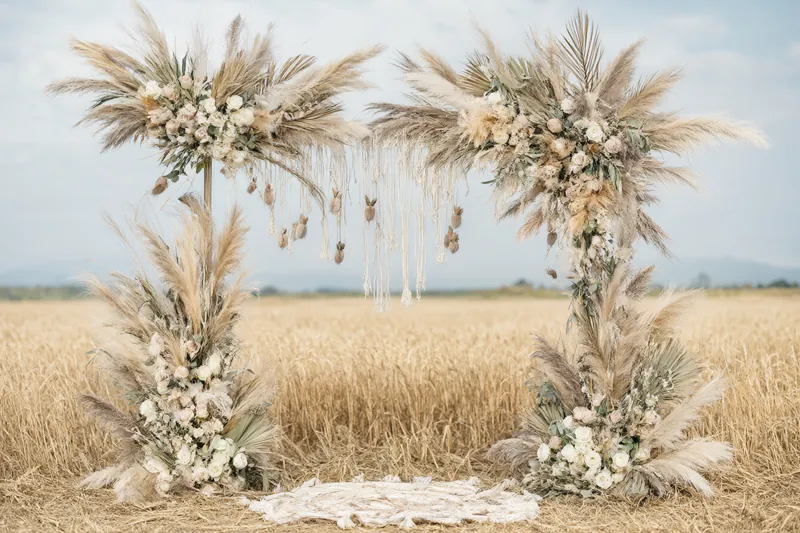
| A pampas arch on its own | Medium to high | Very recognisable as the choice of a period |
| Flowers dyed in unnatural colours | High | Noticeable straight away in photos |
| Decorative objects that are everywhere for a season | High | Tied to a short period |
This table is an editorial assessment, not a forecast. An "at risk" element can look perfect at your wedding if used with restraint.
Trends moment by moment
| Moment | What you often see | Practical tip |
|---|---|---|
| Bouquet | Looser shapes, seasonal flowers, natural fabric ribbons | Test the weight and comfort before the day |
| Ceremony | Asymmetric arches, flowers on the ground, arrangements at the sides instead of full arches | Check with the church or venue what can be placed |
| Aperitivo (drinks reception) | Feature corners, flowers on the bar, potted plants | Leave room for guests to move around |
| Table | Garlands, bud vases, candles in glass | Check the height: guests need to see each other |
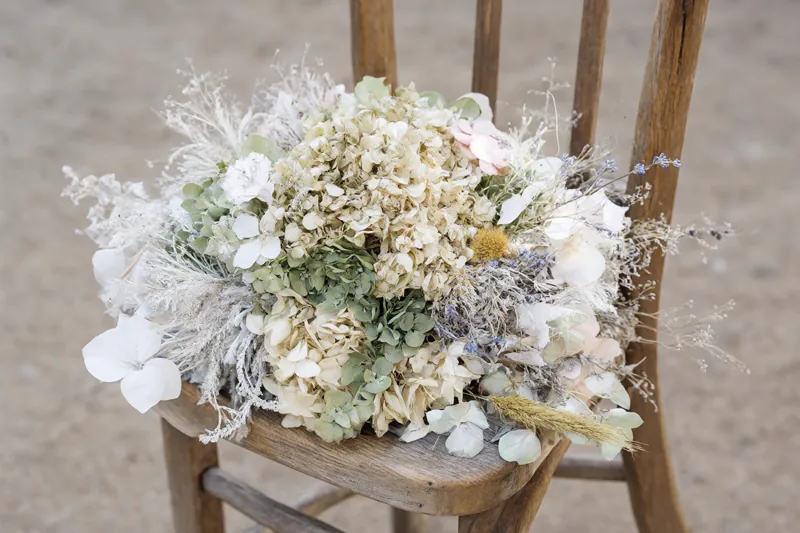
| Cake | A few flowers, often fresh or dried and coordinated | Agree it with whoever makes the cake |
Our guides go into each moment in more depth. For the table, read our guide to table settings and flowers.
Colour trends
Colour choices move more slowly than it seems. White and green remains the classic base. Alongside it you often see warm, dusty tones (peach, terracotta, dusty pink), monochrome palettes and, for evening ceremonies, deeper colours such as burgundy and plum. Very saturated colours and dyed flowers remain niche choices. Rather than following a fashionable colour, it is better to start from the venue and the season: read our guide to wedding flower colour palettes.
Lead flowers, without invented fashions
Some flowers come back again and again in couples' requests: garden roses, peonies, ranunculus, hydrangeas, orchids and calla lilies. They are not passing trends; they are flowers that hold up well in many styles. Alongside them you often see less classic varieties, such as dahlias, cosmos, anemones and dusty-coloured carnations, which were rarely used at weddings until a few years ago. Rather than chasing the flower of the year, ask your florist what looks beautiful and fresh in your month: it is the choice that gives the best result for the least money. Read our guide to seasonal flowers in Italy.
Trends at destination weddings
Couples coming from abroad often look for Italian elements: olive trees, lemons, cypresses, wildflowers, long tables outdoors among the vineyards or by the sea. It is a solid trend because it comes from the landscape. The risk is the postcard effect, with lemons and ceramics everywhere. Read our guide to the Mediterranean style and see our page of destination wedding florists.
How to use a trend without being used by it
- Choose a timeless base, then add one or two on-trend details.
- Put the trend where it is easy to change: a photo corner, the seating plan, an installation.
- Avoid copying a photo exactly: ask your florist to reinterpret it.
- Look at the season: if a trend needs out-of-season flowers, it will cost more and look less good.
To build a consistent base, read our guide to wedding flower styles.
Questions to ask your florist
- Does this idea work at my venue and in my season?
- What do couples ask you for most often, and what do you advise against?
- How would you make this trend less predictable?
- Which elements do you think will still look good in photos over time?
- Where would you concentrate the budget for a strong effect?
To sum up
Trends are useful for finding ideas, less so for making decisions. Start from what you love and what the venue offers you, then use new ideas as accents. To turn your ideas into colours, read our guide to wedding flower colour palettes.
Once you have collected your favourite images, request a quote and ask the florist how they would adapt them to your wedding.